Sometimes your mind suddenly stops working for a moment. You know the answer, but you cannot remember it. You may forget a simple word, make an easy mistake, or lose your train of thought. In casual English, people often call this a brain fart.
The phrase is funny and informal, but it is not suitable for every situation. Knowing other ways to say brain fart can help you explain the same idea in a polite, professional, or more natural way.
Your word choice changes the tone of your message. For example, I had a brain fart sounds casual and humorous, while I had a momentary lapse in concentration sounds more professional.
Learning different alternatives to brain fart can help English learners communicate clearly in conversations, emails, school, and the workplace.
What Does Brain Fart Mean?
Brain fart is an informal expression for a short moment when you cannot think clearly, remember something, or perform a simple mental task.
It does not usually describe a serious problem. Instead, it often refers to a small and temporary mistake.
For example:
- I had a brain fart and forgot my own password.
- Sorry, I had a brain fart there.
The expression is an informal noun phrase. It is also commonly used with have, as in have a brain fart.
The phrase can describe forgetting a word, making an obvious error, confusing two things, or temporarily losing your train of thought.
Some useful synonyms for brain fart include:
- Mental lapse
- Momentary lapse
- Memory lapse
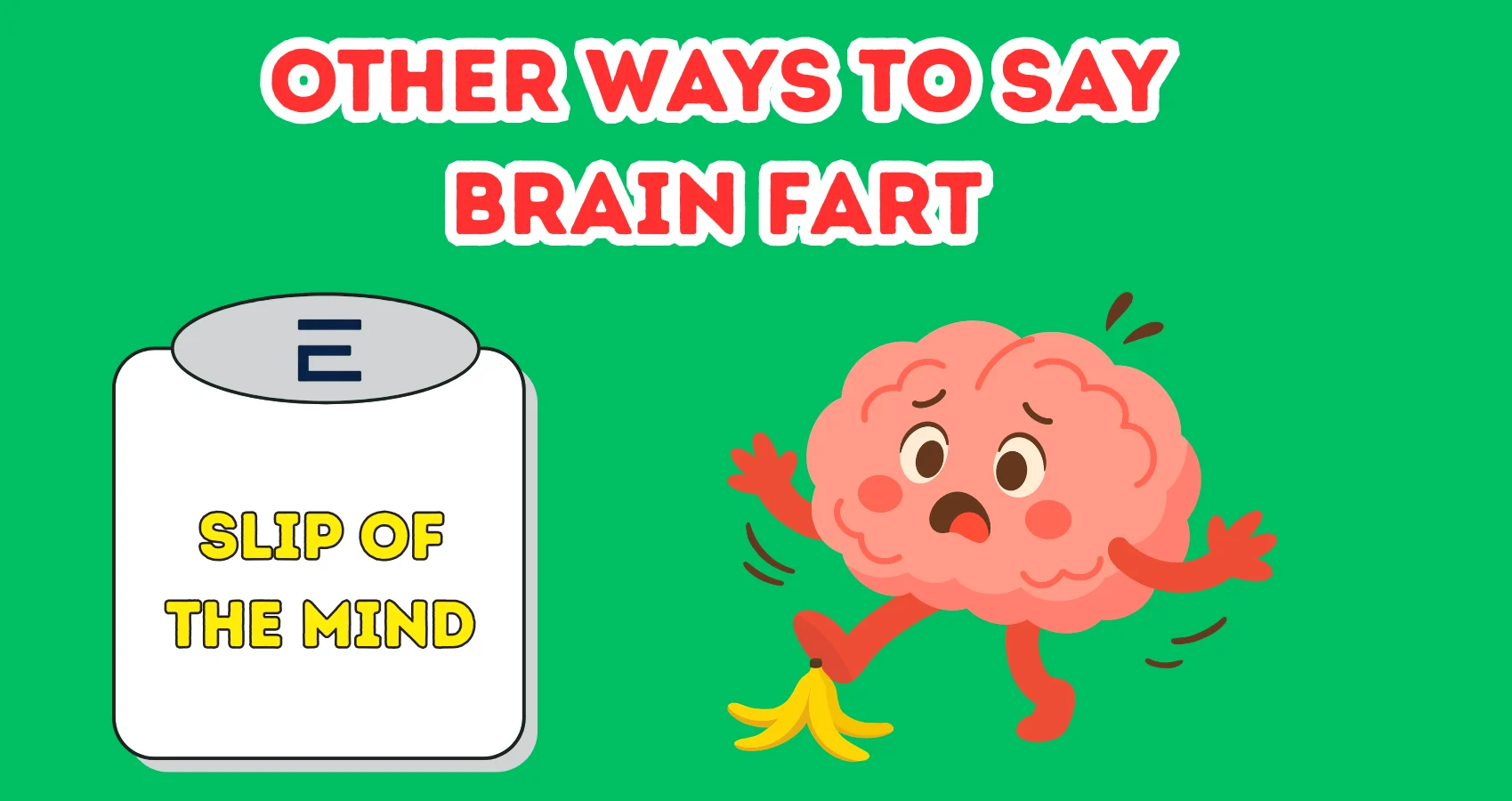
- Slip of the mind
- Moment of confusion
- Lapse in concentration
- Temporary confusion
- Mental block
- Forgetfulness
- Absent-minded moment
The opposite idea would be being focused, clear-headed, alert, or mentally sharp.
When to Use Brain Fart
Spoken English
Brain fart is common in casual spoken English. Friends, classmates, and coworkers may use it when talking informally.
For example:
Sorry, I had a brain fart. I knew the answer a second ago.
It can make a mistake sound less serious and more humorous.
Business English
The phrase should be used carefully at work. It is casual and can sound unprofessional in formal situations.
With close coworkers, it may be acceptable in relaxed conversations.
For example:
I had a brain fart and attached the wrong file. Sorry about that.
For a manager, client, or formal situation, I made a brief error or I overlooked that detail is usually better.
Emails and Messages
In a casual message to a friend, brain fart works well.
For example:
Sorry! Total brain fart. I forgot to send the file.
In a professional email, choose a more polished expression.
For example:
I apologize. I overlooked the attachment in my previous email.
Social Media
Brain fart is perfectly natural in many casual social media posts. It can add humor to a small mistake.
For example:
Complete brain fart today. I walked into the kitchen and forgot why I was there.
It is informal, so it works best when the post has a relaxed tone.
Academic Writing
Avoid brain fart in essays, research papers, and formal academic writing.
Instead, use phrases such as momentary lapse in concentration, temporary difficulty recalling information, or brief lapse in memory.
Professional Meetings
During a relaxed meeting, brain fart may be acceptable among familiar colleagues. However, it is safer to use a neutral phrase when speaking with clients, senior managers, or new professional contacts.
Instead of:
Sorry, brain fart.
You could say:
Sorry, I lost my train of thought for a moment.
Is Brain Fart Polite or Professional?
Brain fart is generally informal rather than formal or professional.
It is not normally considered a serious insult when someone uses it about themselves. However, saying that another person had a brain fart can sound rude or disrespectful.
Polite
I had a brief lapse in concentration.
This sounds respectful and professional.
Neutral
I forgot for a moment.
This is simple and safe in most situations.
Strong
I made a careless mistake.
This is more direct and can sound self-critical.
Soft
I lost my train of thought for a moment.
This sounds gentle and avoids negative language.
Formal
I experienced a momentary lapse in concentration.
This is suitable for formal communication.
Informal
I had a brain fart.
This works well with friends and in relaxed conversations.
Better for workplace: I overlooked that detail.
Avoid in corporate emails: I had a brain fart.
The second version may sound too casual, especially when communicating with clients or senior professionals.
Pros & Cons of Using Brain Fart
✔ Pros
- Sounds natural in casual English
- Can make a mistake sound humorous
- Helps reduce embarrassment
- Common in informal conversations
- Easy to understand from context
- Can describe a very short mental mistake
- Often sounds self-deprecating rather than serious
✘ Cons
- Very informal
- Not ideal for formal writing
- May sound unprofessional at work
- Can sound rude when used about another person
- May not be suitable for academic writing
- Can minimize a serious mistake
- Not appropriate in every cultural or professional setting
Quick Alternatives to Brain Fart
- Mental lapse
- Memory lapse
- Slip of the mind
- Momentary lapse
- Lapse in concentration
- Moment of confusion
- Mental block
- Temporary confusion
- I forgot for a moment
- I lost my train of thought
- I drew a blank
- I wasn’t thinking clearly
- I made a small mistake
- I overlooked that
- I missed that detail
- I got mixed up
- I lost focus
- I had a lapse in judgment
- I made an error
- I momentarily forgot
Mental Lapse
Phrase: Mental lapse
Meaning: A short period when you fail to remember or think clearly.
Explanation: Mental lapse is one of the best neutral alternatives to brain fart. It describes a temporary mistake without the humorous or slightly crude feeling of the original expression. It works well when you want to explain that your mind briefly failed to process something.
Grammar Note: Noun phrase.
Example Sentence: I had a brief mental lapse and entered the wrong number.
Best Use: Workplace, emails, formal conversations, academic contexts.
Worst Use: Very casual conversations where a humorous expression would sound more natural.
Tone: Neutral, professional, polite.
Level: Intermediate.
Similarity Score: 9/10
Replaceability Tip: Use mental lapse when you need a professional version of brain fart.
Memory Lapse
Phrase: Memory lapse
Meaning: A temporary failure to remember something.
Explanation: This is useful when the problem is specifically about forgetting. It is clearer than brain fart when you cannot remember a name, date, fact, or task.
Grammar Note: Noun phrase.
Example Sentence: I had a memory lapse and forgot his name.
Best Use: Everyday English, workplace, emails, professional conversations.
Worst Use: When the problem was poor concentration rather than memory.
Tone: Neutral, polite, professional.
Level: Beginner.
Similarity Score: 9/10
Replaceability Tip: Choose this when forgetting is the main issue.
Slip of the Mind
Phrase: Slip of the mind
Meaning: A brief mistake in remembering something.
Explanation: This phrase sounds gentle and polite. It suggests that you forgot something temporarily without making the mistake sound serious.
Grammar Note: Idiomatic noun phrase.
Example Sentence: It was simply a slip of the mind; I meant to include the attachment.
Best Use: Emails, workplace, polite conversations.
Worst Use: Very casual situations where it may sound slightly formal.
Tone: Soft, polite, professional.
Level: Intermediate.
Similarity Score: 9/10
Replaceability Tip: Use it when you want to explain a small memory mistake without sounding careless.
Momentary Lapse
Phrase: Momentary lapse
Meaning: A very short period of reduced attention or awareness.
Explanation: This expression emphasizes that the problem lasted only a short time. It is useful when you want to make clear that the mistake was temporary.
Grammar Note: Formal noun phrase.
Example Sentence: It was a momentary lapse, and I corrected the error immediately.
Best Use: Professional communication, formal speech, writing.
Worst Use: Casual conversations with close friends.
Tone: Formal, calm, professional.
Level: Advanced.
Similarity Score: 8/10
Replaceability Tip: Use this when you need a polished alternative for a temporary mental mistake.
Lapse in Concentration
Phrase: Lapse in concentration
Meaning: A short period when you stop paying full attention.
Explanation: This is especially useful when you made a mistake because your attention briefly wandered.
Grammar Note: Formal noun phrase.
Example Sentence: The error was caused by a brief lapse in concentration.
Best Use: Workplace, academic writing, formal communication.
Worst Use: Casual texting.
Tone: Formal, professional, neutral.
Level: Advanced.
Similarity Score: 8/10
Replaceability Tip: Choose this when concentration, rather than memory, caused the mistake.
Moment of Confusion
Phrase: Moment of confusion
Meaning: A short period when you are unsure or unable to understand something clearly.
Explanation: This phrase is broader than brain fart. It can describe forgetting, misunderstanding, or briefly losing track of what is happening.
Grammar Note: Noun phrase.
Example Sentence: I had a moment of confusion and took the wrong turn.
Best Use: Everyday English, workplace, customer communication.
Worst Use: When you simply forgot a name or word.
Tone: Neutral, polite, soft.
Level: Beginner.
Similarity Score: 8/10
Replaceability Tip: Use this when your mistake came from temporary confusion.
Mental Block
Phrase: Mental block
Meaning: A situation where you temporarily cannot think of or remember something.
Explanation: A mental block can feel stronger than a simple brain fart. It often describes being unable to recall an answer, idea, word, or solution even though you normally know it.
Grammar Note: Noun phrase.
Example Sentence: I had a mental block and couldn’t remember the answer.
Best Use: School, work, conversations, creative tasks.
Worst Use: A simple typing error or tiny mistake.
Tone: Neutral, conversational, professional.
Level: Intermediate.
Similarity Score: 8/10
Replaceability Tip: Use mental block when you temporarily cannot access information you normally know.
Temporary Confusion
Phrase: Temporary confusion
Meaning: A short period of being confused.
Explanation: This is a clear and neutral expression. It sounds much more formal than brain fart and avoids humorous language.
Grammar Note: Noun phrase.
Example Sentence: The mistake was caused by temporary confusion about the instructions.
Best Use: Workplace, academic writing, formal communication.
Worst Use: Casual conversations where a simpler phrase is better.
Tone: Formal, neutral, professional.
Level: Intermediate.
Similarity Score: 7/10
Replaceability Tip: Choose this when you need clear, professional language.
I Forgot for a Moment
Phrase: I forgot for a moment
Meaning: You temporarily failed to remember something.
Explanation: This is one of the easiest alternatives for English learners. It is direct, natural, and does not sound overly formal.
Grammar Note: Simple past verb phrase.
Example Sentence: Sorry, I forgot for a moment where I put the keys.
Best Use: Everyday conversation, messages, workplace.
Worst Use: When you did not actually forget something.
Tone: Neutral, friendly, polite.
Level: Beginner.
Similarity Score: 9/10
Replaceability Tip: Use this when you want simple English without slang.
I Lost My Train of Thought
Phrase: I lost my train of thought
Meaning: You temporarily forgot what you were saying or thinking.
Explanation: This is a very natural idiom. It is especially useful during conversations, presentations, meetings, and speeches.
Grammar Note: Idiomatic phrase.
Example Sentence: Sorry, I lost my train of thought for a second.
Best Use: Meetings, presentations, conversations, workplace.
Worst Use: Forgetting an object or appointment.
Tone: Friendly, neutral, polite.
Level: Intermediate.
Similarity Score: 9/10
Replaceability Tip: Use it when you forget what you were talking about.
I Drew a Blank
Phrase: I drew a blank
Meaning: You could not remember or think of an answer.
Explanation: This is a common informal idiom. It is particularly useful when someone asks you a question and your mind suddenly gives you nothing.
Grammar Note: Idiom.
Example Sentence: She asked me his name, but I drew a blank.
Best Use: Casual conversations, interviews, everyday English.
Worst Use: Formal academic writing.
Tone: Informal, natural, friendly.
Level: Intermediate.
Similarity Score: 9/10
Replaceability Tip: Use it when your mind suddenly cannot produce an answer.
I Wasn’t Thinking Clearly
Phrase: I wasn’t thinking clearly
Meaning: Your thoughts were not focused or organized at that moment.
Explanation: This expression is honest and neutral. It can describe a mistake caused by distraction, tiredness, stress, or confusion.
Grammar Note: Past continuous verb phrase.
Example Sentence: I wasn’t thinking clearly when I entered the wrong date.
Best Use: Everyday English, workplace, apologies.
Worst Use: Situations where a specific memory problem needs explanation.
Tone: Neutral, sincere, polite.
Level: Beginner.
Similarity Score: 8/10
Replaceability Tip: Choose this when you want to take responsibility without using slang.
I Overlooked That
Phrase: I overlooked that
Meaning: You failed to notice something.
Explanation: This is an excellent workplace alternative. It does not suggest that you could not think. Instead, it says that you missed something that should have been noticed.
Grammar Note: Verb phrase.
Example Sentence: I apologize. I overlooked that detail in the report.
Best Use: Professional emails, workplace, business communication.
Worst Use: When you genuinely forgot information.
Tone: Professional, polite, accountable.
Level: Intermediate.
Similarity Score: 7/10
Replaceability Tip: Use it when the mistake happened because you failed to notice something.
I Missed That Detail
Phrase: I missed that detail
Meaning: You failed to notice or remember a specific piece of information.
Explanation: This sounds professional without being overly formal. It also shows that you recognize the exact source of the mistake.
Grammar Note: Verb phrase.
Example Sentence: Thanks for pointing that out. I missed that detail.
Best Use: Workplace, emails, meetings.
Worst Use: When you simply forgot an answer.
Tone: Neutral, professional, polite.
Level: Beginner.
Similarity Score: 7/10
Replaceability Tip: Use it when you want a simple professional way to acknowledge an oversight.
I Got Mixed Up
Phrase: I got mixed up
Meaning: You confused two or more things.
Explanation: This is common in casual and everyday English. It works well when you accidentally switch names, dates, numbers, or instructions.
Grammar Note: Phrasal verb.
Example Sentence: Sorry, I got mixed up and thought the meeting was tomorrow.
Best Use: Everyday conversation, messages, informal workplace communication.
Worst Use: Formal reports or serious professional errors.
Tone: Friendly, informal, neutral.
Level: Beginner.
Similarity Score: 8/10
Replaceability Tip: Choose this when confusion between two things caused the mistake.
I Lost Focus
Phrase: I lost focus
Meaning: You stopped paying full attention.
Explanation: This phrase is simple and useful. It focuses on attention rather than memory.
Grammar Note: Verb phrase.
Example Sentence: I lost focus for a moment and missed the last instruction.
Best Use: School, workplace, everyday conversation.
Worst Use: When the problem had nothing to do with attention.
Tone: Neutral, honest, professional.
Level: Beginner.
Similarity Score: 8/10
Replaceability Tip: Use this when distraction caused your mistake.
I Made a Small Mistake
Phrase: I made a small mistake
Meaning: You made a minor error.
Explanation: This is one of the safest alternatives because it does not explain the exact mental reason behind the mistake. It simply acknowledges what happened.
Grammar Note: Simple verb phrase.
Example Sentence: I made a small mistake in the calculation and corrected it.
Best Use: Workplace, emails, school, everyday English.
Worst Use: When the mistake is actually serious and needs a more specific explanation.
Tone: Neutral, polite, professional.
Level: Beginner.
Similarity Score: 7/10
Replaceability Tip: Use this when you want a simple and safe replacement for informal slang.
I Got Distracted
Phrase: I got distracted
Meaning: Something caused you to stop focusing on the task.
Explanation: This phrase explains why you temporarily made an error or forgot something.
Grammar Note: Phrasal verb.
Example Sentence: I got distracted and forgot to reply to your message.
Best Use: Everyday English, workplace conversations, messages.
Worst Use: When there was no distraction.
Tone: Neutral, conversational.
Level: Beginner.
Similarity Score: 7/10
Replaceability Tip: Use it when an outside event caused your attention to move away from the task.
I Momentarily Forgot
Phrase: I momentarily forgot
Meaning: You forgot something for a very short time.
Explanation: This is a polished alternative that works well in professional situations. It clearly communicates that the memory problem was temporary.
Grammar Note: Adverb plus verb phrase.
Example Sentence: I momentarily forgot the name of the software we discussed.
Best Use: Professional conversations, emails, formal speech.
Worst Use: Very casual conversations where it may sound slightly formal.
Tone: Polite, formal, professional.
Level: Intermediate.
Similarity Score: 9/10
Replaceability Tip: Choose this when you need a professional replacement that still sounds natural.
I Made an Error
Phrase: I made an error
Meaning: You did something incorrectly.
Explanation: This is direct and professional. It does not make excuses or use humor.
Grammar Note: Formal verb phrase.
Example Sentence: I made an error in the report and have corrected it.
Best Use: Business emails, reports, academic settings, workplace.
Worst Use: Casual conversations where it may sound overly serious.
Tone: Formal, professional, direct.
Level: Beginner.
Similarity Score: 6/10
Replaceability Tip: Use it when accountability matters more than explaining the mental mistake.
I Had a Lapse in Judgment
Phrase: I had a lapse in judgment
Meaning: You briefly made a poor decision or failed to think carefully.
Explanation: This phrase is stronger than brain fart. It suggests that the problem involved a decision rather than simply forgetting something.
Grammar Note: Formal idiomatic phrase.
Example Sentence: I had a lapse in judgment and approved the document too quickly.
Best Use: Formal apologies, professional communication.
Worst Use: Forgetting a person’s name or a simple word.
Tone: Formal, serious, accountable.
Level: Advanced.
Similarity Score: 5/10
Replaceability Tip: Use this only when the mistake involved poor judgment.
Mini Dialogue Examples
Formal Conversation
Manager: I noticed that the figures in the report were entered incorrectly.
Employee: I apologize. I made an error while reviewing the figures.
Manager: Please correct them before the final submission.
Employee: Certainly. I will update the report immediately.
Informal Conversation
Friend: What was the name of that restaurant we visited last week?
You: Oh, I know it. Wait…
Friend: Remember?
You: Sorry, I drew a blank for a second.
Business Email Style
Subject: Correction to the Report
Dear James,
Thank you for pointing out the issue. I overlooked that detail during my initial review.
I have corrected the report and attached the updated version for your reference.
Best regards,
Alex
Mistakes to Avoid
- Using brain fart in formal writing: Avoid it in academic papers, official documents, and formal business emails.
- Calling someone else’s mistake a brain fart: It can sound insulting, even if you mean it as a joke.
- Using mental lapse for every mistake: A mental lapse usually suggests a temporary failure in thinking or attention.
- Confusing a memory lapse with distraction: Use memory lapse when you forgot something and lost focus when attention was the problem.
- Using mental block for every small error: A mental block often suggests that you cannot access an answer or idea.
- Using overly formal language with friends: Saying I experienced a momentary lapse in concentration in a casual chat may sound unnatural.
- Using slang with clients: Professional communication usually benefits from clear, neutral language.
Cultural & Tone Tips
The expression brain fart is strongly casual. Native English speakers often use it humorously when talking about their own small mistakes.
It is usually safer to use the expression about yourself than about another person.
For example:
I had a brain fart.
This can sound funny and harmless.
But:
You had a brain fart.
This can sound insulting, especially if the listener does not know you well.
In US English, brain fart is widely understood as informal slang. It is often used humorously in everyday speech.
In UK English, the expression is also understood, although speakers may choose alternatives such as senior moment, slip of the mind, lost my train of thought, or momentary lapse, depending on the situation.
In casual social English, slang and humorous expressions are more acceptable. Brain fart, I drew a blank, and I got mixed up can all sound natural.
In professional settings, neutral language is usually safer. I overlooked that, I made an error, and I lost my train of thought can communicate the same general idea without sounding too casual.
Remember that tone also depends on your relationship with the listener. A phrase that works with a close friend may not work with a customer or manager.
Comparison of the Best Alternatives
| Phrase | Tone | Best Context | Professional Level | Example |
|---|---|---|---|---|
| Mental lapse | Neutral | Workplace | High | I had a brief mental lapse. |
| Memory lapse | Polite | Everyday and work | High | I had a memory lapse. |
| I overlooked that | Professional | Business | Very high | I overlooked that detail. |
| I lost my train of thought | Friendly | Meetings | High | I lost my train of thought. |
| I drew a blank | Informal | Conversation | Medium | I drew a blank when asked. |
| I got mixed up | Casual | Everyday English | Medium | I got mixed up about the dates. |
| I made an error | Formal | Business and academic | Very high | I made an error in the report. |
FAQs
Is Brain Fart Rude?
Brain fart is not usually rude when you use it to describe your own small mistake. However, using it to describe another person’s mistake can sound disrespectful or insulting.
Is Brain Fart Okay in Emails?
It can be fine in a casual email to a friend or close coworker. It is generally better to avoid it in formal business emails. Use I overlooked that, I made an error, or I forgot for a moment instead.
What Is the Most Formal Alternative to Brain Fart?
I made an error is a clear formal alternative when you simply need to acknowledge a mistake. Lapse in concentration or momentary lapse can work when the mental cause is important.
What Is the Most Polite Alternative to Brain Fart?
I had a brief lapse in concentration is a polite and professional option. I overlooked that detail is also useful when the mistake involved missing information.
What Should Beginners Use Instead of Brain Fart?
Beginners can use simple expressions such as I forgot for a moment, I got mixed up, I made a small mistake, and I lost focus. These are easy to understand and useful in many situations.
What Is a Casual Way to Say Brain Fart?
I drew a blank, I got mixed up, and I lost my train of thought are natural casual alternatives. They are often easier to use in conversation because they describe the specific type of mistake.
Conclusion:
Knowing other ways to say brain fart helps you choose language that fits the situation. Brain fart is useful slang for casual conversations, but it may sound too informal for professional or academic communication.
For work, expressions such as I overlooked that, I made an error, and mental lapse are safer choices. For everyday conversations, I drew a blank, I got mixed up, and I lost my train of thought sound natural.
The key is to match your words with your audience and setting. Practice these alternatives in real conversations, emails, meetings, and messages. Over time, you will find it easier to express small mistakes clearly and naturally.

I’m John Mark, the creator of EnglishGrammarline. I share simple and meaningful insights into dreams, their symbols, and possible interpretations. My goal is to help readers understand their dreams in an easy and interesting way.