
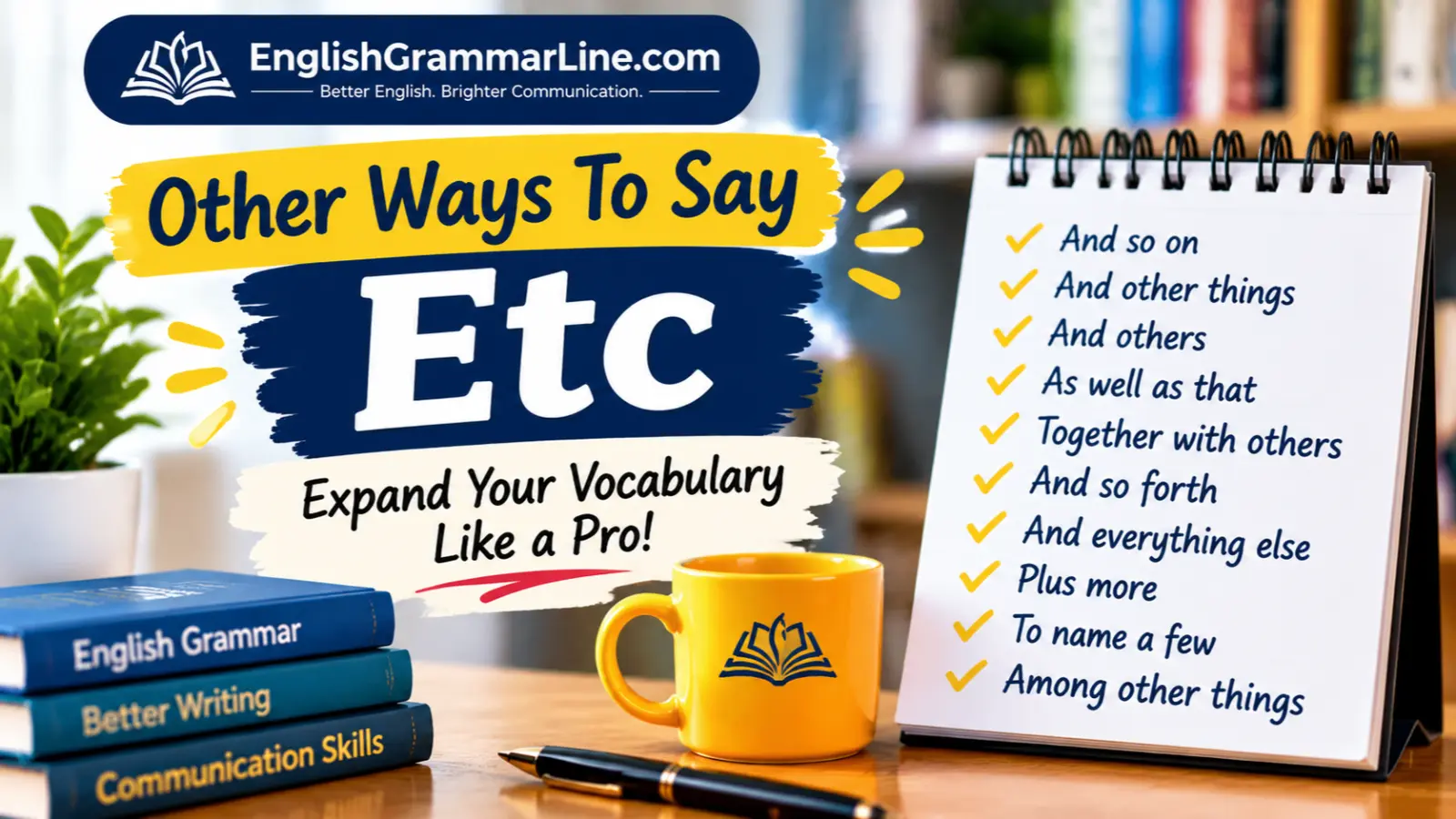
The abbreviation etc. is short for the Latin phrase et cetera, which means and other similar things. We use it when we want to mention a few examples without listing everything. It is common in emails, essays, business documents, and everyday conversations. However, using etc. too often can make your writing seem vague or incomplete.
Learning other ways to say etc. helps you express your ideas more clearly. You can choose words that fit your audience, writing style, and purpose. For example, books, pens, notebooks, etc. is common in everyday writing, while books, pens, notebooks, and other supplies sounds clearer in formal writing.
The best alternative depends on the situation. Some expressions are suitable for academic papers, while others work better in business emails or casual conversations. This guide explores useful synonyms and alternatives to help you write with confidence.
What Does Etc. Mean?
Etc. is an abbreviation of the Latin expression et cetera. It means and other things of the same kind or and so on.
It tells readers that a list continues beyond the examples you have provided. It saves space and prevents long lists from becoming repetitive.
Grammar note: Etc. is an abbreviation, not a verb, noun, idiom, or phrasal verb. It is usually placed at the end of a list.
Examples:
- Please bring pens, pencils, notebooks, etc.
- We discussed marketing, sales, customer service, etc.
Other expressions with a similar meaning include and so on, and the like, among others, and other related items.
However, these phrases are not always interchangeable. For example, among others usually refers to additional people or things in a group, while and so forth often continues a list of actions, ideas, or examples.
When to Use Etc.
Spoken English
In everyday speech, people often use and so on or and things like that instead of saying the letters in etc.
Example: We talked about movies, music, and things like that.
These alternatives sound natural and help conversations flow smoothly.
Business English
In business writing, etc. can be useful for short lists. However, clearer expressions often make professional messages easier to understand.
Example: Please bring your laptop, charger, notebook, and other necessary equipment.
This sentence sounds more complete than ending the list with etc.
Emails and Messages
You can use etc. in informal or routine emails when the examples are easy to understand.
Example: Please send the invoices, receipts, delivery notes, etc.
For important instructions, consider using and any other relevant documents so the reader knows what else to include.
Social Media
In social media posts, casual alternatives such as and so on, and all that, and and stuff can sound natural.
Example: We spent the day shopping, eating, taking pictures, and all that.
Choose an expression that matches your audience and tone.
Academic Writing
In academic writing, avoid using etc. when it makes your meaning unclear. It is often better to name the remaining categories or use a precise expression.
Example: The study examined reading, writing, listening, speaking, and other language skills.
This is clearer than leaving the reader to guess what the list includes.
Professional Meetings
During meetings, you can use and so forth, among other topics, or other related matters to summarize a list.
Example: We will discuss the budget, hiring plans, training, and other related matters.
These expressions help you sound organized and professional.
Is Etc. Polite or Professional?
Etc. is neutral and generally acceptable, but its suitability depends on the context.
- Polite: Please bring your notebook, pen, and other necessary materials.
- Neutral: We need chairs, tables, lights, etc.
- Strong and precise: The report must include the budget, timeline, risks, and all supporting documents.
- Soft and conversational: We can discuss the budget, the schedule, and things like that.
In formal writing, it is usually better to replace etc. with a phrase that clearly explains what else belongs in the list.
Better for workplace: and other relevant documents
Avoid in formal reports: ending a detailed list with etc. when the missing items are important.
Pros and Cons of Using Etc.
✔ Pros
- Saves space in a list.
- Helps avoid unnecessary repetition.
- Works well in informal writing.
- Is widely understood by English speakers.
- Makes short lists easier to write.
✘ Cons
- Can make writing vague.
- May leave readers unsure about what is included.
- Can look careless in formal documents.
- Is not suitable for every academic context.
- Can weaken instructions when specific details are needed.
Quick Alternatives to Etc.
- And so on
- And so forth
- And the like
- And other things
- And other items
- Among others
- Among other things
- Other related items
- Other similar things
- And similar things
- And additional items
- And more
- Including other things
- And other examples
- And other relevant details
- And all that
- And things like that
- And other such items
- Along with others
- And related matters
And So On
Phrase: And so on
Meaning: And other similar things that continue the list.
Explanation: This is one of the most common alternatives to etc. It works well when the reader can easily understand what other items belong in the list. It is natural in both spoken and written English.
Grammar Note: Fixed expression used to continue a list.
Example Sentence: We need to buy milk, bread, eggs, and so on.
Best Use: Everyday conversations, informal writing, messages, and general explanations.
Worst Use: Formal instructions where every item must be clearly identified.
Tone: Neutral, conversational.
Level: Beginner.
Similarity Score: 10/10.
Replaceability Tip: Choose and so on when you want a simple replacement for etc. without changing the meaning.
And So Forth
Phrase: And so forth
Meaning: And other similar things or examples.
Explanation: This expression is slightly more formal than and so on. It is useful when listing several related actions, ideas, or categories. It sounds natural in presentations and professional conversations.
Grammar Note: Fixed expression.
Example Sentence: The training covers communication, teamwork, time management, and so forth.
Best Use: Workplace communication, presentations, essays, and formal speech.
Worst Use: Very casual conversations where it may sound unnecessarily formal.
Tone: Neutral, slightly formal.
Level: Intermediate.
Similarity Score: 10/10.
Replaceability Tip: Use this expression when you want a polished alternative to etc. in professional writing.
And the Like
Phrase: And the like
Meaning: Other things of a similar kind.
Explanation: This expression tells readers that other items belong to the same category. It is useful when you want to avoid listing every example. It can sound more formal than and so on.
Grammar Note: Fixed expression.
Example Sentence: The store sells notebooks, folders, pens, and the like.
Best Use: Business writing, general descriptions, formal explanations.
Worst Use: Lists where the remaining items are very different from the examples.
Tone: Neutral, formal.
Level: Intermediate.
Similarity Score: 9/10.
Replaceability Tip: Use it when the remaining items are similar in type to those already mentioned.
Among Others
Phrase: Among others
Meaning: Including other people or things that are not all named.
Explanation: This phrase is especially useful when naming a few members of a larger group. It does not always work as a direct replacement for etc., because it often refers to people, organizations, or specific members.
Grammar Note: Prepositional phrase.
Example Sentence: The meeting included the sales manager, the finance director, and several others.
Best Use: Business writing, reports, biographies, and formal descriptions.
Worst Use: General lists of unrelated objects when the meaning is unclear.
Tone: Neutral, professional.
Level: Intermediate.
Similarity Score: 7/10.
Replaceability Tip: Choose among others when you want to show that the named examples are only part of a larger group.
Among Other Things
Phrase: Among other things
Meaning: In addition to the things already mentioned.
Explanation: This expression works well when discussing several activities, responsibilities, subjects, or issues. It tells the reader that the list is not complete without suggesting that every remaining item is identical.
Grammar Note: Prepositional phrase.
Example Sentence: Her role includes managing schedules, preparing reports, and handling customer requests, among other things.
Best Use: Workplace emails, essays, professional descriptions.
Worst Use: Situations where the reader needs a complete list.
Tone: Neutral, professional.
Level: Intermediate.
Similarity Score: 8/10.
Replaceability Tip: Use it when you are describing a person’s duties or a topic that includes several additional details.
And Other Things
Phrase: And other things
Meaning: Other items or details not listed.
Explanation: This is a simple expression that most English learners can use comfortably. It is flexible, but it may be vague if the reader needs to know exactly what else is included.
Grammar Note: Coordinating phrase.
Example Sentence: Please bring your books, pens, notebooks, and other things you need for class.
Best Use: Everyday speech, informal messages, simple writing.
Worst Use: Detailed professional instructions.
Tone: Casual, neutral.
Level: Beginner.
Similarity Score: 8/10.
Replaceability Tip: Choose it when you want plain, easy English rather than a formal expression.
And Other Items
Phrase: And other items
Meaning: Additional objects or entries in a list.
Explanation: This phrase is useful when talking about physical products, supplies, documents, or things that belong to a defined group. It is clearer than etc. when the reader needs a general idea of what remains.
Grammar Note: Noun phrase.
Example Sentence: The package includes a charger, a cable, a user guide, and other items.
Best Use: Product descriptions, workplace lists, shopping lists, reports.
Worst Use: Lists of abstract ideas or actions where items sounds unnatural.
Tone: Neutral, professional.
Level: Beginner.
Similarity Score: 8/10.
Replaceability Tip: Use it when the list contains objects or entries rather than actions.
Other Related Items
Phrase: Other related items
Meaning: Additional things connected to the subject.
Explanation: This expression makes the relationship between the items clear. It works well in business and administrative writing, especially when discussing files, equipment, or resources.
Grammar Note: Noun phrase.
Example Sentence: Please upload the contract, invoice, project plan, and other related items.
Best Use: Workplace emails, administrative tasks, reports.
Worst Use: Casual chats where a shorter phrase is more natural.
Tone: Professional, neutral.
Level: Intermediate.
Similarity Score: 8/10.
Replaceability Tip: Choose this when the extra items must relate directly to the topic.
Other Similar Things
Phrase: Other similar things
Meaning: Additional things that resemble the examples given.
Explanation: This expression is clear and easy to understand. It is especially helpful for learners because it explains the relationship between the examples and the unlisted items.
Grammar Note: Noun phrase.
Example Sentence: The shop sells candles, soaps, bath salts, and other similar things.
Best Use: Everyday English, explanations, informal writing.
Worst Use: Formal reports that need exact categories.
Tone: Neutral, conversational.
Level: Beginner.
Similarity Score: 9/10.
Replaceability Tip: Use it when you want to emphasize that the remaining examples are similar to the ones already named.
And Similar Things
Phrase: And similar things
Meaning: Additional things of the same general type.
Explanation: This phrase works much like other similar things. It can make a sentence sound more complete than etc. because it states the connection between the examples.
Grammar Note: Coordinating phrase.
Example Sentence: The course covers grammar, vocabulary, pronunciation, and similar things.
Best Use: Educational explanations, casual writing, spoken English.
Worst Use: Formal documents that require exact details.
Tone: Neutral, simple.
Level: Beginner.
Similarity Score: 9/10.
Replaceability Tip: Choose this when you are explaining a broad category to someone who may not know the subject well.
And Additional Items
Phrase: And additional items
Meaning: More items beyond those already mentioned.
Explanation: This expression is useful when you want a professional tone. It clearly indicates that the list contains more entries, although it does not identify every one.
Grammar Note: Noun phrase.
Example Sentence: The application requires identification, proof of address, photographs, and additional items.
Best Use: Business documents, applications, formal instructions.
Worst Use: Friendly conversations where it sounds stiff.
Tone: Formal, professional.
Level: Intermediate.
Similarity Score: 8/10.
Replaceability Tip: Use it when writing formal instructions or describing extra requirements.
And More
Phrase: And more
Meaning: Additional examples or items beyond those listed.
Explanation: This short phrase is widely used in advertising, product descriptions, and everyday writing. It can make a list feel open-ended, but it may not provide enough detail for formal instructions.
Grammar Note: Coordinating phrase.
Example Sentence: Our library offers novels, magazines, newspapers, and more.
Best Use: Marketing, websites, social media, informal writing.
Worst Use: Academic writing that requires specific details.
Tone: Friendly, neutral, promotional.
Level: Beginner.
Similarity Score: 8/10.
Replaceability Tip: Choose it when you want to suggest variety without listing every option.
Including Other Things
Phrase: Including other things
Meaning: With additional things that are part of the same group.
Explanation: This phrase helps show that a list contains more than the examples provided. It works best when the surrounding sentence explains the category.
Grammar Note: Participial phrase.
Example Sentence: The workshop covers writing skills, grammar, editing, including other things that students may find useful.
Best Use: Informal explanations and general descriptions.
Worst Use: Sentences where the grammar becomes awkward or the list is unclear.
Tone: Neutral.
Level: Intermediate.
Similarity Score: 7/10.
Replaceability Tip: Use it carefully and revise the sentence if the phrase makes the list difficult to follow.
And Other Examples
Phrase: And other examples
Meaning: Additional examples that support the same point.
Explanation: This is useful in teaching, essays, and explanations. It is more specific than etc. because it tells readers that the unlisted items are examples rather than physical objects.
Grammar Note: Noun phrase.
Example Sentence: Similes, metaphors, personification, and other examples appear in the poem.
Best Use: Academic writing, lessons, presentations.
Worst Use: Lists of objects or people when examples is not the right word.
Tone: Neutral, educational.
Level: Intermediate.
Similarity Score: 8/10.
Replaceability Tip: Choose it when listing examples of a concept, rule, or literary device.
And Other Relevant Details
Phrase: And other relevant details
Meaning: Additional information connected to the topic.
Explanation: This expression is suitable when the unlisted information is important to a discussion or task. It sounds more precise than etc. in business communication.
Grammar Note: Noun phrase.
Example Sentence: Please include the project dates, budget, deadlines, and other relevant details.
Best Use: Business emails, reports, instructions, formal writing.
Worst Use: Casual lists of everyday objects.
Tone: Professional, clear.
Level: Intermediate.
Similarity Score: 8/10.
Replaceability Tip: Use it when you want readers to include any further information that matters to the task.
And All That
Phrase: And all that
Meaning: And other things connected with the subject.
Explanation: This is a casual expression used in conversation. It can suggest that the speaker does not want to list every detail. Depending on delivery, it can sound relaxed or dismissive.
Grammar Note: Informal fixed expression.
Example Sentence: We talked about school, exams, homework, and all that.
Best Use: Friendly conversations and informal messages.
Worst Use: Formal emails, academic papers, and official documents.
Tone: Casual, relaxed.
Level: Beginner.
Similarity Score: 8/10.
Replaceability Tip: Use it with friends when the details are not important.
And Things Like That
Phrase: And things like that
Meaning: And other similar things.
Explanation: This is a common spoken alternative to etc. It is easy to understand and useful when talking about activities, interests, or examples without naming them all.
Grammar Note: Informal fixed expression.
Example Sentence: She enjoys painting, gardening, cooking, and things like that.
Best Use: Everyday speech, casual messages, informal descriptions.
Worst Use: Formal business writing.
Tone: Friendly, conversational.
Level: Beginner.
Similarity Score: 9/10.
Replaceability Tip: Choose it when you want your conversation to sound relaxed and natural.
And Other Such Items
Phrase: And other such items
Meaning: Other items of the same type.
Explanation: This expression is more formal and structured. It works well in official descriptions when the reader can understand the category from the examples.
Grammar Note: Formal noun phrase.
Example Sentence: The shipment contained cables, adapters, batteries, and other such items.
Best Use: Reports, formal descriptions, business documents.
Worst Use: Casual conversation.
Tone: Formal, precise.
Level: Advanced.
Similarity Score: 9/10.
Replaceability Tip: Use it when you need a formal way to refer to additional items in a defined category.
Along With Others
Phrase: Along with others
Meaning: Together with additional people or things.
Explanation: This expression works best when the sentence names a person, item, or group and then refers to additional members. It is not a direct replacement for etc. in every list.
Grammar Note: Prepositional phrase.
Example Sentence: The director, along with others from the team, attended the event.
Best Use: Professional writing, reports, formal descriptions.
Worst Use: Lists where the relationship between the items is unclear.
Tone: Neutral, professional.
Level: Intermediate.
Similarity Score: 6/10.
Replaceability Tip: Choose it when you mean that someone or something is included with other members of a group.
And Related Matters
Phrase: And related matters
Meaning: Other connected subjects or issues.
Explanation: This expression is useful in professional settings where a list contains topics rather than physical objects. It can make a meeting agenda or report sound organized.
Grammar Note: Formal noun phrase.
Example Sentence: The meeting will cover staffing, the annual budget, workplace policies, and related matters.
Best Use: Meeting agendas, reports, official emails.
Worst Use: Casual conversations or lists of unrelated objects.
Tone: Formal, professional.
Level: Advanced.
Similarity Score: 8/10.
Replaceability Tip: Use it when discussing related issues that do not need to be listed individually.
Mini Dialogue Examples
Formal Dialogue
Manager: Have we included all the required documents?
Assistant: We have included the application form, identification, proof of address, and other relevant documents.
Manager: Excellent. Please make sure the final list is complete.
Informal Dialogue
Friend A: What do you usually do on weekends?
Friend B: I enjoy reading, watching movies, going for walks, and things like that.
Friend A: That sounds relaxing!
Business Email Example
Subject: Documents Required for Registration
Dear Team,
Please submit the completed form, proof of identity, contact details, and any other relevant documents by Friday.
If you have questions about the requirements, please let me know.
Best regards,
Alex
Mistakes to Avoid
- Using etc. when the list must be complete: If readers need every item, write the full list.
- Using etc. and and so on together: These expressions serve the same purpose, so using both is usually unnecessary.
- Using etc. after people without a clear reason: Depending on the sentence, among others may sound more natural.
- Using casual expressions in formal writing: Phrases such as and all that may sound too informal for a report.
- Forgetting the period: The standard written form is etc.
- Using etc. to hide unclear meaning: Make sure readers understand what kind of items are missing.
- Repeating the same alternative: Vary your language when it improves clarity, but do not change expressions just for the sake of variety.
Cultural and Tone Tips
Native speakers use etc. frequently, but they expect the surrounding sentence to make the missing examples clear. If the category is obvious, the abbreviation is usually easy to understand. If the list is important, a vague ending may frustrate the reader.
In UK English, and so forth, and so on, and the like are all familiar expressions. The best choice depends on the level of formality.
In US English, and so on and and more are common in everyday speech and marketing. In business communication, other relevant items or other related details may be more useful.
In casual social English, people often say and stuff, and things like that, or and all that. These expressions are friendly but should generally be avoided in formal reports and academic essays.
A useful rule is to choose the alternative that explains the list most clearly. Clarity is more important than sounding formal.
Best Alternatives to Etc. at a Glance
| Phrase | Tone | Best Context | Professional Level | Example |
|---|---|---|---|---|
| And so on | Neutral | Everyday English | Medium | Bring pens, paper, and so on. |
| And so forth | Slightly formal | Presentations | High | We discussed costs, deadlines, and so forth. |
| Among others | Professional | Reports | High | Several managers, among others, attended. |
| And the like | Formal | Descriptions | High | The shop sells books, pens, and the like. |
| Other relevant details | Professional | Emails | Very high | Please provide dates and other relevant details. |
| And more | Friendly | Websites and marketing | Medium | Find books, guides, and more. |
| And things like that | Casual | Conversations | Low | I enjoy music and things like that. |
FAQs
What Is the Best Alternative to Etc.?
And so on is one of the best general alternatives. It is simple, familiar, and suitable for many everyday situations. For formal writing, other relevant items may be clearer.
Is Etc. Formal or Informal?
Etc. is neutral and can appear in both formal and informal writing. However, in important professional or academic documents, a more specific phrase can make the meaning clearer.
Can I Use Etc. in a Professional Email?
Yes. You can use it in routine emails when the missing examples are obvious. For important instructions, consider writing and any other relevant documents or naming the remaining items.
What Is the Most Formal Alternative to Etc.?
There is no single best choice for every situation. Other relevant items, and related matters, and and other such items are useful formal alternatives, depending on what you are describing.
Is And So On the Same as Etc.?
They have very similar meanings. Both indicate that a list continues. And so on is a written-out expression, while etc. is an abbreviation.
Should I Use Etc. in Academic Writing?
You can use it in some academic contexts, but avoid it when it makes your argument vague. Naming the remaining categories or using a specific phrase often produces clearer academic writing.
Conclusion
Learning other ways to say etc. helps you write with greater clarity and confidence. Expressions such as and so on, and so forth, among others, and other relevant items can make your sentences sound more natural and suitable for different situations.
The key is to choose words that fit your audience. Use casual expressions in everyday conversations and clearer, more specific alternatives in business emails, reports, and academic writing. Remember that etc. is useful when the missing examples are obvious, but it should not replace important information. Practice these alternatives in real sentences to build your vocabulary and improve your English fluency.

I’m John Mark, the creator of EnglishGrammarline. I share simple and meaningful insights into dreams, their symbols, and possible interpretations. My goal is to help readers understand their dreams in an easy and interesting way.
3 thoughts on “85+ Practical Other Ways To Say Etc for Clear Communication”