
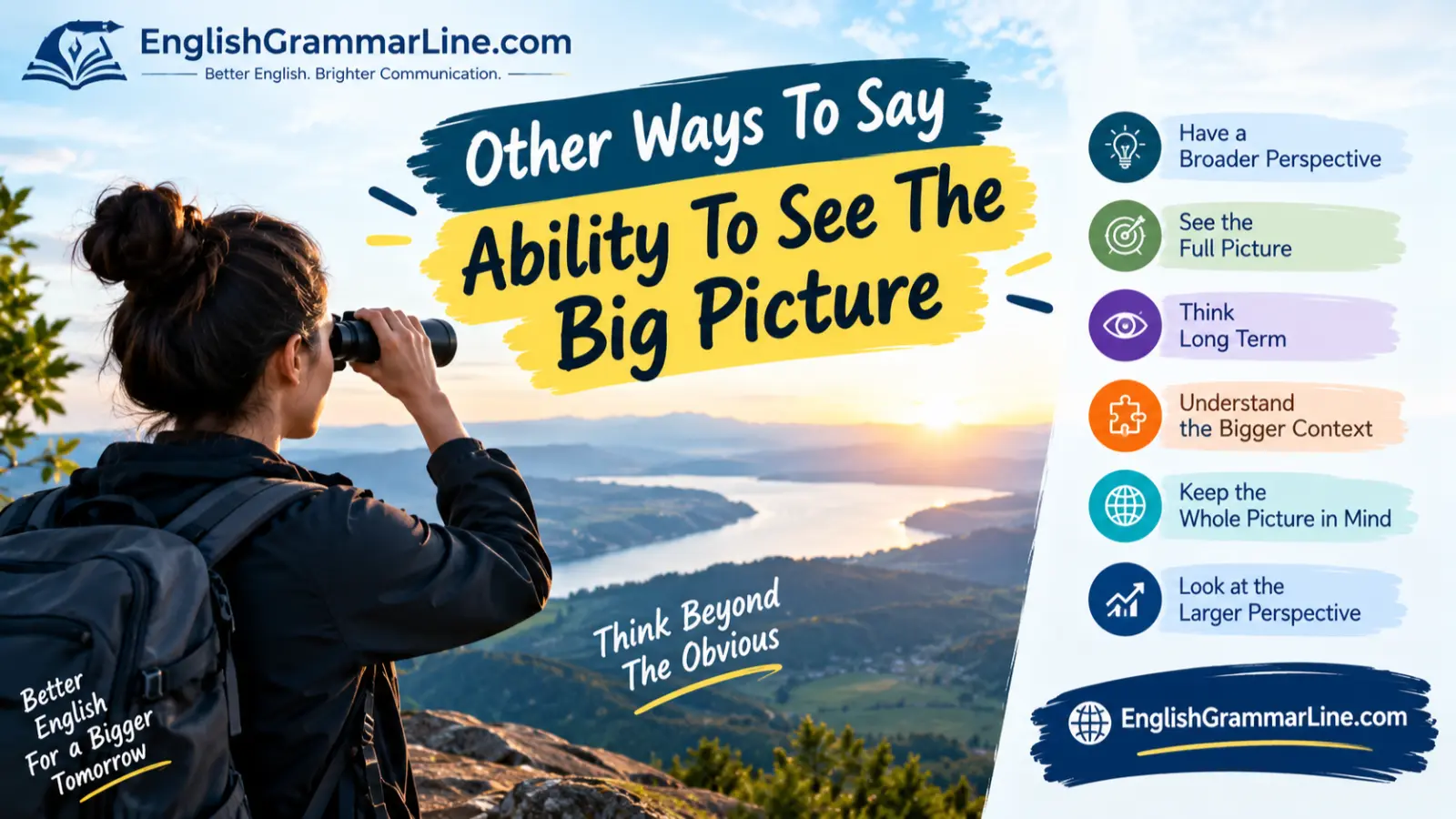
The phrase ability to see the big picture describes someone who understands the overall goal instead of focusing only on small details. It is a valuable skill in business, education, leadership, and everyday life. People with this ability can connect ideas, understand how things work together, and make better decisions.
Learning other ways to say ability to see the big picture helps you express this skill more clearly. You might need it for a job interview, a resume, a performance review, or a professional email. Choosing the right words can make your message sound more confident and natural.
For example, She has the ability to see the big picture is clear and direct. She has a strong strategic mindset sounds more professional and focuses on planning and long-term goals.
This guide explores useful synonyms and alternatives to help you describe this important skill in different situations.
What Does Ability to See the Big Picture Mean?
The ability to see the big picture means understanding the whole situation rather than focusing only on individual parts. It involves seeing connections, recognizing patterns, and understanding how small actions affect larger goals.
This expression is often used to describe people who think strategically, solve problems, and make decisions based on the wider situation.
Grammar Note: This is a noun phrase. The word ability is a noun, while to see the big picture explains the skill being described.
Examples:
- A good manager needs the ability to see the big picture.
- Her big-picture thinking helped the team solve a difficult problem.
Related expressions include strategic thinking, a broad perspective, systems thinking, and long-term vision.
The opposite might be tunnel vision, short-sighted thinking, or an excessive focus on details.
When to Use Ability to See the Big Picture
Spoken English
Use this phrase when talking about someone’s ability to understand an entire situation.
Example: He can see the big picture even when things get complicated.
In casual conversations, you can also say someone looks at the whole situation.
Business English
In business, this skill helps people understand company goals, customer needs, market changes, and team priorities.
Example: Our new director has a strong strategic mindset and understands the company’s long-term goals.
Emails and Messages
You can use these expressions when praising a colleague or describing someone’s strengths.
Example: I appreciate your ability to look at the bigger picture when making decisions.
For a more formal message, try your strategic perspective or your ability to understand the wider business context.
Social Media
For social media posts, simpler expressions often work best.
Example: Great leaders see the bigger picture and help others move forward.
You might also use seeing beyond the details or keeping your eyes on the bigger goal.
Academic Writing
In academic writing, this ability may relate to systems thinking, critical thinking, or understanding the wider context of a subject.
Example: A broader perspective allows researchers to understand the relationship between individual findings and wider patterns.
Professional Meetings
During meetings, these phrases help explain how someone connects daily tasks with wider goals.
Example: Let’s take a step back and consider the overall objective before making a decision.
Is Ability to See the Big Picture Polite or Professional?
Yes. The phrase is positive, respectful, and suitable for professional communication. It often describes leadership, planning, problem-solving, and decision-making skills.
Its tone depends on the expression you choose.
- Polite: You have a helpful understanding of the wider situation.
- Neutral: You understand the overall picture.
- Strong: You demonstrate exceptional strategic thinking.
- Soft: You seem to have a good sense of how everything fits together.
- Formal: You demonstrate the ability to assess the broader organizational context.
- Informal: You can see the bigger picture.
Better for workplace: She has a strong strategic mindset and understands our long-term goals.
Avoid in corporate resumes: She gets the general idea of things.
The second sentence is vague and may sound less impressive. A resume should describe the skill in clear, specific language.
Pros and Cons of Using Ability to See the Big Picture
✔ Pros
- Describes a valuable professional skill.
- Shows awareness of wider goals.
- Works well in resumes and interviews.
- Highlights leadership and planning abilities.
- Helps explain strong decision-making.
- Fits business and academic communication.
- Shows that someone can connect ideas.
✘ Cons
- Can sound vague without an example.
- May be overused in resumes.
- Does not always show practical results.
- Can suggest that someone overlooks small details if used carelessly.
- May sound less specific than strategic thinking or systems thinking.
Quick Alternatives to Ability to See the Big Picture
- Strategic thinking
- A broad perspective
- A long-term vision
- Seeing the bigger picture
- A holistic perspective
- Systems thinking
- Big-picture thinking
- The ability to think strategically
- Understanding the wider context
- A wider outlook
- Seeing the whole picture
- Forward-thinking
- A global perspective
- Connecting the dots
- Seeing the broader view
- Long-range thinking
- An overall perspective
- The ability to recognize patterns
- Thinking beyond the details
- Understanding the wider implications
Strategic Thinking
Phrase: Strategic thinking
Meaning: The ability to plan and make decisions with long-term goals in mind.
Explanation: This is one of the strongest professional alternatives. It suggests that someone considers future outcomes, available resources, risks, and opportunities before acting. It is especially useful when describing managers, business leaders, and problem-solvers.
Grammar Note: Noun phrase.
Example Sentence: Her strategic thinking helped the company prepare for future challenges.
Best Use: Resumes, interviews, business meetings, leadership reviews.
Worst Use: When you only mean that someone understands a simple situation without planning or analysis.
Tone: Professional, confident, analytical.
Level: Intermediate.
Similarity Score: 9/10.
Replaceability Tip: Use this phrase when the ability to see the big picture involves planning, judgment, and long-term decisions.
A Broad Perspective
Phrase: A broad perspective
Meaning: The ability to consider different parts of a situation.
Explanation: This phrase emphasizes openness and a wider understanding. It suggests that someone does not judge an issue from only one point of view.
Grammar Note: Noun phrase.
Example Sentence: Her broad perspective helped the team understand the problem from several angles.
Best Use: Academic writing, professional discussions, reports, interviews.
Worst Use: When you need to describe a specific planning or leadership skill.
Tone: Neutral, thoughtful, professional.
Level: Intermediate.
Similarity Score: 9/10.
Replaceability Tip: Choose this when you want to highlight someone’s ability to consider the wider situation and different viewpoints.
A Long-Term Vision
Phrase: A long-term vision
Meaning: A clear idea of what should be achieved in the future.
Explanation: This phrase focuses on future goals rather than the whole situation alone. It is useful for describing people who understand where a project, team, or organization should be heading.
Grammar Note: Noun phrase.
Example Sentence: The founder’s long-term vision helped guide the company’s growth.
Best Use: Leadership, business plans, interviews, professional profiles.
Worst Use: When describing someone who understands a situation but has no future plan.
Tone: Professional, ambitious, forward-looking.
Level: Intermediate.
Similarity Score: 8/10.
Replaceability Tip: Use it when the wider perspective is mainly about future direction and goals.
Seeing the Bigger Picture
Phrase: Seeing the bigger picture
Meaning: Understanding how different parts of a situation fit together.
Explanation: This is a natural and widely used version of the original idea. It works in everyday conversation and professional settings without sounding too formal.
Grammar Note: Gerund phrase.
Example Sentence: Seeing the bigger picture helped us choose the right solution.
Best Use: Conversations, meetings, emails, presentations.
Worst Use: Highly technical reports where a more precise term is needed.
Tone: Neutral, natural, professional.
Level: Beginner.
Similarity Score: 10/10.
Replaceability Tip: Choose this when you want to keep the original meaning with simple, familiar wording.
A Holistic Perspective
Phrase: A holistic perspective
Meaning: Understanding a situation by considering all its parts and how they affect one another.
Explanation: This phrase suggests that the person considers the whole system rather than treating each part separately. It is useful when discussing complex problems, organizations, health, education, or research.
Grammar Note: Noun phrase.
Example Sentence: A holistic perspective helped the team identify the root cause of the problem.
Best Use: Academic writing, strategy, complex problem-solving, professional reports.
Worst Use: Casual conversations where simpler words would be clearer.
Tone: Formal, analytical, thoughtful.
Level: Advanced.
Similarity Score: 9/10.
Replaceability Tip: Use it when the person understands how several connected factors influence the overall result.
Systems Thinking
Phrase: Systems thinking
Meaning: Understanding how different parts of a system influence one another.
Explanation: This is a more specific term than seeing the big picture. It focuses on relationships, patterns, causes, and effects within a larger system.
Grammar Note: Noun phrase.
Example Sentence: Systems thinking helped the team understand why one small change affected the entire process.
Best Use: Business strategy, engineering, research, management, complex problem-solving.
Worst Use: Simple situations where no connected system is involved.
Tone: Technical, analytical, professional.
Level: Advanced.
Similarity Score: 8/10.
Replaceability Tip: Choose this when you want to emphasize an understanding of how different elements work together.
Big-Picture Thinking
Phrase: Big-picture thinking
Meaning: Focusing on the overall goal instead of getting lost in small details.
Explanation: This phrase is a direct and natural alternative. It is especially useful in professional settings where you want to describe someone’s approach to planning and decision-making.
Grammar Note: Compound noun phrase.
Example Sentence: Her big-picture thinking helped the department stay focused on its main goals.
Best Use: Resumes, workplace discussions, leadership reviews, interviews.
Worst Use: When the task requires careful attention to small details rather than an overall view.
Tone: Professional, neutral, positive.
Level: Intermediate.
Similarity Score: 10/10.
Replaceability Tip: Use it when describing the skill itself rather than a single decision or opinion.
Understanding the Wider Context
Phrase: Understanding the wider context
Meaning: Knowing the background and circumstances that affect a situation.
Explanation: This phrase highlights the importance of considering information beyond the immediate problem. It works well in analysis, writing, and decision-making.
Grammar Note: Gerund phrase.
Example Sentence: Understanding the wider context helped us respond to the customer’s concerns.
Best Use: Reports, emails, research, business discussions.
Worst Use: Casual situations where a short phrase would be more natural.
Tone: Professional, analytical, neutral.
Level: Intermediate.
Similarity Score: 9/10.
Replaceability Tip: Choose it when background information and surrounding circumstances matter most.
A Wider Outlook
Phrase: A wider outlook
Meaning: A way of thinking that considers more than the immediate situation.
Explanation: This expression suggests openness to new ideas, possibilities, and viewpoints. It is less technical than strategic thinking and can describe both personal and professional strengths.
Grammar Note: Noun phrase.
Example Sentence: Working with international clients gave her a wider outlook on business.
Best Use: Personal development, interviews, workplace communication.
Worst Use: When you need to show a measurable strategic skill.
Tone: Thoughtful, positive, neutral.
Level: Intermediate.
Similarity Score: 8/10.
Replaceability Tip: Use it when the person’s wider understanding comes from experience or exposure to different ideas.
Seeing the Whole Picture
Phrase: Seeing the whole picture
Meaning: Understanding all the important parts of a situation.
Explanation: This phrase is very close to the original. It emphasizes having enough information to understand the situation as a whole.
Grammar Note: Gerund phrase.
Example Sentence: Before making a decision, we need to see the whole picture.
Best Use: Everyday speech, business discussions, problem-solving.
Worst Use: Technical writing that needs a more exact description.
Tone: Neutral, clear, conversational.
Level: Beginner.
Similarity Score: 10/10.
Replaceability Tip: Choose it when you want a simple alternative that keeps almost the same meaning.
Forward-Thinking
Phrase: Forward-thinking
Meaning: Considering future needs, changes, and opportunities.
Explanation: This expression describes a person or approach that looks ahead. It often suggests innovation and readiness for change, although it does not automatically mean the person understands every part of a situation.
Grammar Note: Compound adjective.
Example Sentence: We need a forward-thinking leader who can prepare the business for future challenges.
Best Use: Resumes, leadership profiles, business strategy, company descriptions.
Worst Use: When you only want to describe an understanding of the current situation.
Tone: Positive, professional, ambitious.
Level: Intermediate.
Similarity Score: 7/10.
Replaceability Tip: Use it when the big-picture ability is strongly connected to future opportunities and change.
Connecting the Dots
Phrase: Connecting the dots
Meaning: Recognizing links between separate facts, ideas, or events.
Explanation: This familiar expression describes the ability to notice patterns and relationships. It is useful when someone sees connections that others may miss.
Grammar Note: Idiom.
Example Sentence: He was good at connecting the dots and finding the real cause of the problem.
Best Use: Conversations, meetings, problem-solving, informal professional writing.
Worst Use: Highly formal documents that require precise technical language.
Tone: Friendly, intelligent, conversational.
Level: Intermediate.
Similarity Score: 8/10.
Replaceability Tip: Choose it when the person’s strength is recognizing patterns or links between pieces of information.
A Global Perspective
Phrase: A global perspective
Meaning: Understanding issues from an international or worldwide viewpoint.
Explanation: This expression can describe a broad understanding of global markets, cultures, events, or business conditions. It is more specific than the original phrase because it often refers to worldwide matters.
Grammar Note: Noun phrase.
Example Sentence: Her global perspective helped the company understand the needs of customers in different countries.
Best Use: International business, education, research, global strategy.
Worst Use: Situations that concern only a small local issue.
Tone: Professional, informed, broad-minded.
Level: Intermediate.
Similarity Score: 7/10.
Replaceability Tip: Use it when seeing the big picture involves international trends or different cultures.
Long-Range Thinking
Phrase: Long-range thinking
Meaning: Considering future outcomes over an extended period.
Explanation: This expression focuses on planning beyond immediate needs. It suggests that someone considers how today’s choices may affect future results.
Grammar Note: Compound noun phrase.
Example Sentence: Long-range thinking helped the organization invest in sustainable growth.
Best Use: Strategic planning, business reports, leadership, policy discussions.
Worst Use: Short tasks that require an immediate decision only.
Tone: Professional, analytical, forward-looking.
Level: Advanced.
Similarity Score: 8/10.
Replaceability Tip: Choose it when long-term consequences matter more than immediate results.
An Overall Perspective
Phrase: An overall perspective
Meaning: An understanding of the general situation.
Explanation: This is a clear and fairly formal expression. It helps describe a person’s ability to consider the main points before reaching a conclusion.
Grammar Note: Noun phrase.
Example Sentence: An overall perspective is important when reviewing the department’s performance.
Best Use: Reports, meetings, academic writing, professional communication.
Worst Use: Casual chats where the phrase may sound stiff.
Tone: Neutral, formal, analytical.
Level: Intermediate.
Similarity Score: 9/10.
Replaceability Tip: Use it when you need a professional expression for understanding a situation as a whole.
Thinking Beyond the Details
Phrase: Thinking beyond the details
Meaning: Looking past small facts to understand the larger goal.
Explanation: This expression is useful when someone spends too much time on minor issues. It emphasizes the importance of balancing details with the main objective.
Grammar Note: Gerund phrase.
Example Sentence: A strong project leader knows when to think beyond the details and focus on the final outcome.
Best Use: Leadership, workplace feedback, project management, interviews.
Worst Use: Jobs where accuracy and detailed review are the main priorities.
Tone: Professional, practical, direct.
Level: Intermediate.
Similarity Score: 9/10.
Replaceability Tip: Choose this phrase when you want to stress the difference between minor details and the main goal.
Understanding the Wider Implications
Phrase: Understanding the wider implications
Meaning: Recognizing the larger effects or consequences of a decision or event.
Explanation: This phrase is useful when a person’s big-picture skill involves predicting how one action may affect other people, processes, or future results.
Grammar Note: Gerund phrase.
Example Sentence: Understanding the wider implications of the policy helped us avoid costly mistakes.
Best Use: Business reports, academic writing, risk assessment, policy discussions.
Worst Use: Casual conversations about simple choices.
Tone: Formal, analytical, professional.
Level: Advanced.
Similarity Score: 8/10.
Replaceability Tip: Use it when the key skill is understanding the consequences of an action beyond its immediate result.
Strategic Perspective
Phrase: Strategic perspective
Meaning: The ability to view decisions in relation to wider goals and priorities.
Explanation: This phrase combines a broad view with a focus on planning. It is especially strong in business writing because it suggests that someone understands both the current situation and the direction the organization needs to take.
Grammar Note: Noun phrase.
Example Sentence: Her strategic perspective helped us choose the best use of our resources.
Best Use: Resumes, executive profiles, performance reviews, business meetings.
Worst Use: Informal conversations where simple language is more suitable.
Tone: Professional, confident, analytical.
Level: Advanced.
Similarity Score: 9/10.
Replaceability Tip: Choose it when you want to describe a person’s broad understanding in a leadership or decision-making context.
Mini Dialogue Examples
Formal Dialogue
Manager: Why do you think Maya is ready for a leadership role?
Colleague: She has strong strategic thinking skills and understands how daily work supports our long-term goals.
Manager: I agree. Her ability to see the wider context is a real strength.
Informal Dialogue
Friend A: Why did you change your plan?
Friend B: I took a step back and looked at the whole picture.
Friend A: That makes sense. Sometimes we focus too much on small things.
Business Email Example
Subject: Project Review
Dear Team,
Thank you for sharing your feedback. Your strategic perspective has helped us understand the wider business goals and identify the best next steps.
Let’s keep the overall objective in mind as we finalize the plan.
Best regards,
Alex
Mistakes to Avoid
- Using strategic thinking for every situation: This phrase specifically suggests planning and decision-making, not just general understanding.
- Confusing big-picture thinking with ignoring details: Seeing the whole picture means balancing the overall goal with important facts.
- Using vague resume statements: Add an example of how your broad perspective helped solve a problem or improve a result.
- Using holistic when you mean global: Holistic means considering connected parts of a whole. Global often refers to worldwide issues.
- Calling someone forward-thinking without evidence: Explain how the person anticipates changes or prepares for future needs.
- Using connecting the dots in highly formal writing: Choose a more precise expression if the document requires a formal tone.
- Forgetting the audience: A job interview may call for strategic thinking, while a casual conversation may suit seeing the bigger picture.
Cultural & Tone Tips
The phrase ability to see the big picture is generally viewed positively in English-speaking workplaces. It suggests maturity, good judgment, and an understanding of wider goals.
In UK English, expressions such as a broader perspective, the bigger picture, and a wider view fit naturally in both professional and everyday conversations.
In US English, big-picture thinking, strategic mindset, and long-term vision are common choices in business discussions and professional profiles.
In casual social English, people often use simpler expressions such as seeing the whole picture, looking at the bigger picture, or connecting the dots.
Remember that seeing the big picture does not mean ignoring small details. Strong decision-makers know when to focus on the wider goal and when to examine the details carefully.
For professional writing, support the phrase with a real example. Instead of saying only that you have strategic thinking skills, explain how you used them to solve a problem, improve a process, or reach a goal.
Comparison of the Best Alternatives
| Phrase | Tone | Best Context | Professional Level | Example |
|---|---|---|---|---|
| Strategic thinking | Analytical | Leadership and planning | Very high | She uses strategic thinking to plan ahead. |
| A broad perspective | Thoughtful | General professional use | High | He brings a broad perspective to the team. |
| Big-picture thinking | Professional | Resumes and interviews | High | Her big-picture thinking keeps us focused. |
| A holistic perspective | Analytical | Complex problems | High | We need a holistic perspective on the issue. |
| Connecting the dots | Conversational | Problem-solving | Medium | He is skilled at connecting the dots. |
| A long-term vision | Ambitious | Leadership and business | Very high | She has a clear long-term vision. |
| Understanding the wider context | Formal | Research and reports | High | Understanding the wider context is essential. |
FAQs
Is Ability to See the Big Picture a Professional Skill?
Yes. It is a valuable skill in leadership, management, planning, and problem-solving. It shows that someone can connect daily tasks with wider goals.
What Is the Most Professional Alternative to Ability to See the Big Picture?
Strategic thinking is one of the strongest professional alternatives. Strategic perspective is also useful for resumes, interviews, and leadership profiles.
What Is the Best Alternative for a Resume?
Big-picture thinking, strategic thinking, and long-term vision are strong options. The best choice depends on the role and the skill you want to highlight.
What Is a Simple Alternative for Beginners?
Seeing the whole picture is easy to understand and closely matches the original meaning. Looking at the bigger picture is also natural in everyday English.
Is Strategic Thinking the Same as Seeing the Big Picture?
They are closely related, but not exactly the same. Seeing the big picture means understanding the overall situation. Strategic thinking adds planning, priorities, and decisions that support long-term goals.
What Is the Opposite of Seeing the Big Picture?
Tunnel vision is a common opposite. It describes focusing too narrowly on one thing while missing other important parts of a situation. Short-sighted thinking is another option when someone fails to consider future consequences.
Conclusion
Learning other ways to say ability to see the big picture helps you describe an important skill with greater clarity and confidence. Expressions such as strategic thinking, a broad perspective, big-picture thinking, and a long-term vision can strengthen your professional communication.
The best choice depends on what you want to express. Use simple phrases in everyday conversations and more precise terms in resumes, reports, and business meetings. Remember to support your words with real examples that show how you understand wider goals and solve problems. Practice these alternatives in your writing and speech to build a stronger vocabulary and communicate more naturally.

I’m John Mark, the creator of EnglishGrammarline. I share simple and meaningful insights into dreams, their symbols, and possible interpretations. My goal is to help readers understand their dreams in an easy and interesting way.