
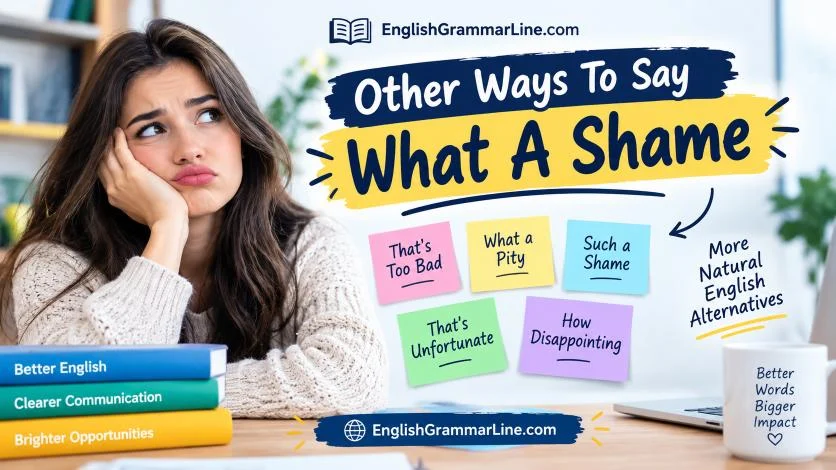
What a shame is a common English expression used when something disappointing, unfortunate, or sad happens. It shows that you feel sorry about a situation or wish things had turned out differently. While it is natural and useful, using the same phrase every time can make your English sound repetitive.
Learning other ways to say what a shame gives you more choices. You can sound sympathetic, polite, professional, friendly, or casual depending on the situation. This is especially helpful in emails, workplace conversations, academic writing, social media, and everyday speech.
For example, a casual speaker might say, That’s a shame! In a professional email, you might write, That is unfortunate to hear. Both express disappointment, but the tone is different. Choosing the right words helps you communicate your feelings clearly while matching the situation and the person you are speaking to.
What Does What a Shame Mean?
What a shame is an expression used to show disappointment, sympathy, regret, or sadness about something unfortunate.
It does not usually mean that someone has done something shameful. Instead, shame in this expression refers to an unfortunate or disappointing situation.
For example:
You missed the concert? What a shame!
The event was canceled because of the storm. What a shame.
Grammatically, what a shame is an exclamatory phrase. It is often used as a complete sentence in conversation.
Some common synonyms and related expressions include:
- That’s unfortunate
- That’s too bad
- That’s disappointing
- I’m sorry to hear that
- What a pity
- That’s regrettable
- That’s unfortunate to hear
- It’s a shame
- What a disappointment
- That’s sad
The tone can range from warm and sympathetic to formal and professional.
When to Use What a Shame
Spoken English
What a shame is very common in spoken English. People use it when reacting to disappointing news.
For example:
You can’t come to the party? What a shame!
It can sound warm and natural when spoken with a sympathetic tone.
Business English
In business settings, what a shame may sound slightly casual. It can still be used in friendly workplace conversations, but more professional alternatives may be better for formal situations.
For example:
That’s unfortunate. I hope we can find another solution.
This sounds more professional than What a shame.
Emails and Messages
In personal messages, what a shame is perfectly natural.
For example:
You won’t be able to join us? What a shame!
In professional emails, consider phrases such as:
I’m sorry to hear that.
or
That is unfortunate to hear.
Social Media
Social media often uses casual expressions. What a shame, That’s too bad, and So unfortunate can all work depending on the context.
For example:
The festival got canceled? What a shame!
A more casual response could be:
Oh no, that’s too bad!
Academic Writing
What a shame is usually too conversational for formal academic writing. Academic writers normally choose objective expressions such as:
This is unfortunate.
This outcome is disappointing.
The result is regrettable.
The choice depends on how formal the paper needs to be.
Professional Meetings
During meetings, that’s unfortunate or that’s disappointing can be better choices than what a shame.
For example:
The client has decided to postpone the project.
That’s unfortunate. Let’s discuss our next steps.
This sounds professional and keeps the conversation focused on the solution.
Is What a Shame Polite or Professional?
What a shame is generally polite, but it is more conversational than formal.
Its tone can change based on context.
Polite:
I’m sorry to hear that.
Neutral:
That’s unfortunate.
Soft:
That’s too bad.
Strong:
That’s really disappointing.
Formal:
That is regrettable.
Friendly:
What a shame!
For the workplace, that’s unfortunate, I’m sorry to hear that, and that’s disappointing are usually safer choices.
Better for workplace:
I’m sorry to hear that the meeting was canceled.
More casual:
What a shame the meeting was canceled!
The second sentence is not rude. It simply sounds more conversational.
Pros & Cons of Using What a Shame
✔ Pros
- Easy to understand
- Natural in everyday English
- Shows sympathy
- Works well in spoken English
- Sounds friendly
- Useful for reacting to disappointing news
- Can express mild sadness without sounding dramatic
✘ Cons
- Can sound too casual in formal writing
- May sound insincere if used with the wrong tone
- Can be vague
- May not be strong enough for serious situations
- Can sound repetitive if overused
- May not clearly show what action should happen next
Quick Alternatives to What a Shame
- That’s unfortunate
- That’s too bad
- That’s disappointing
- I’m sorry to hear that
- What a pity
- That’s regrettable
- It’s unfortunate
- That’s really unfortunate
- What a disappointment
- That’s sad
- I’m sorry about that
- That’s unfortunate to hear
- It’s a pity
- That’s disappointing to hear
- I regret to hear that
- That’s not good news
- That’s unfortunate news
- What an unfortunate situation
- That must be disappointing
- I understand your disappointment
That’s Unfortunate
Phrase: That’s unfortunate
Meaning: This means that something bad, disappointing, or unwanted has happened.
Explanation: This is one of the best professional alternatives to what a shame. It expresses sympathy without sounding overly emotional. It works well when you want to acknowledge bad news and remain calm.
Grammar Note: Adjective phrase.
Example Sentence: That’s unfortunate. I hope we can find another solution.
Best Use: Workplace, business emails, professional conversations, formal speech.
Worst Use: Very emotional personal situations where a warmer response is needed.
Tone: Professional, polite, neutral.
Level: Beginner.
Similarity Score: 9/10
Replaceability Tip: Choose this instead of what a shame when you want a more professional tone.
That’s Too Bad
Phrase: That’s too bad
Meaning: This means something is unfortunate or disappointing.
Explanation: This is a very natural everyday expression. It sounds friendly and sympathetic. It is less formal than that’s unfortunate.
Grammar Note: Informal conversational expression.
Example Sentence: You can’t make it to dinner? That’s too bad.
Best Use: Casual conversation, messages, friends, family.
Worst Use: Formal business reports or serious official communication.
Tone: Friendly, casual, sympathetic.
Level: Beginner.
Similarity Score: 10/10
Replaceability Tip: Use it when talking casually with someone about disappointing news.
That’s Disappointing
Phrase: That’s disappointing
Meaning: Something did not happen as hoped or expected.
Explanation: This phrase directly expresses disappointment. It can be sympathetic, but it can also show that you personally expected a better result.
Grammar Note: Adjective phrase.
Example Sentence: The company canceled the event? That’s disappointing.
Best Use: Workplace, conversations, emails, personal situations.
Worst Use: When you want to avoid sounding critical.
Tone: Neutral, professional, direct.
Level: Beginner.
Similarity Score: 9/10
Replaceability Tip: Use this when disappointment is stronger than simple sympathy.
I’m Sorry to Hear That
Phrase: I’m sorry to hear that
Meaning: A polite way to show sympathy after hearing bad or disappointing news.
Explanation: This is one of the safest expressions for sensitive situations. It focuses on the other person’s feelings rather than simply describing the event.
Grammar Note: Polite fixed expression.
Example Sentence: I’m sorry to hear that your trip was canceled.
Best Use: Emails, workplace, personal conversations, serious situations.
Worst Use: Very minor situations where it may sound overly serious.
Tone: Warm, polite, sympathetic, professional.
Level: Beginner.
Similarity Score: 10/10
Replaceability Tip: Choose this when you want to sound caring and respectful.
What a Pity
Phrase: What a pity
Meaning: An expression showing that something is unfortunate or disappointing.
Explanation: This is very close to what a shame. It is common in both British and international English and can sound slightly more polished.
Grammar Note: Exclamatory phrase.
Example Sentence: You missed the last train? What a pity.
Best Use: Spoken English, polite conversations, British English.
Worst Use: Extremely formal business documents.
Tone: Polite, sympathetic, slightly formal.
Level: Intermediate.
Similarity Score: 10/10
Replaceability Tip: Use it when you want a direct synonym that still sounds natural.
That’s Regrettable
Phrase: That’s regrettable
Meaning: Something is unfortunate and causes regret.
Explanation: This is a formal expression. It is useful when discussing an unwanted outcome in professional or official communication.
Grammar Note: Formal adjective phrase.
Example Sentence: The delay is regrettable, but we are working to resolve the issue.
Best Use: Business, formal emails, official communication.
Worst Use: Casual conversations with close friends.
Tone: Formal, professional, serious.
Level: Advanced.
Similarity Score: 8/10
Replaceability Tip: Choose this when what a shame feels too casual for the situation.
It’s a Shame
Phrase: It’s a shame
Meaning: Something is unfortunate or disappointing.
Explanation: This is perhaps the closest grammatical alternative to what a shame. It can be used in both casual and semi-formal conversations.
Grammar Note: Fixed expression.
Example Sentence: It’s a shame that you couldn’t join us.
Best Use: Everyday conversation, messages, informal workplace communication.
Worst Use: Very formal documents.
Tone: Friendly, neutral, sympathetic.
Level: Beginner.
Similarity Score: 10/10
Replaceability Tip: Use this when you want a slightly softer sentence instead of an exclamation.
What a Disappointment
Phrase: What a disappointment
Meaning: An expression showing strong disappointment.
Explanation: This is stronger than what a shame. It focuses directly on the disappointing result.
Grammar Note: Exclamatory noun phrase.
Example Sentence: The concert was canceled at the last minute. What a disappointment!
Best Use: Casual speech, reviews, personal conversations.
Worst Use: When you need to sound neutral and objective.
Tone: Emotional, strong, disappointed.
Level: Intermediate.
Similarity Score: 8/10
Replaceability Tip: Use this when you want to emphasize your disappointment.
That’s Sad
Phrase: That’s sad
Meaning: This means something makes you feel unhappy or sorry.
Explanation: It is simple and natural. However, it can sound too direct or emotional in some professional situations.
Grammar Note: Adjective phrase.
Example Sentence: They had to close the community center. That’s sad.
Best Use: Casual conversation, personal messages.
Worst Use: Formal business communication.
Tone: Emotional, simple, sympathetic.
Level: Beginner.
Similarity Score: 8/10
Replaceability Tip: Choose it when the situation is genuinely sad rather than simply inconvenient.
I’m Sorry About That
Phrase: I’m sorry about that
Meaning: A polite way to express sympathy or regret.
Explanation: This expression is flexible. It can show sympathy when something goes wrong, even when you are not personally responsible.
Grammar Note: Fixed conversational phrase.
Example Sentence: Your order arrived late? I’m sorry about that.
Best Use: Customer service, workplace, everyday conversations.
Worst Use: Academic writing.
Tone: Polite, warm, friendly.
Level: Beginner.
Similarity Score: 9/10
Replaceability Tip: Use it when you want to sound more caring than simply saying that’s unfortunate.
That’s Really Unfortunate
Phrase: That’s really unfortunate
Meaning: Something is particularly disappointing or unfortunate.
Explanation: Adding really makes the sympathy stronger. It works well when the situation is more serious than an ordinary inconvenience.
Grammar Note: Intensified adjective phrase.
Example Sentence: That’s really unfortunate. I hope everything works out.
Best Use: Professional conversations, personal situations, emails.
Worst Use: Very minor problems where it may sound exaggerated.
Tone: Sympathetic, professional, serious.
Level: Intermediate.
Similarity Score: 9/10
Replaceability Tip: Use this when that’s unfortunate feels too weak.
That Must Be Disappointing
Phrase: That must be disappointing
Meaning: You recognize that someone probably feels disappointed.
Explanation: This phrase focuses on the other person’s feelings. It can sound especially caring because it shows that you understand their emotional reaction.
Grammar Note: Modal verb construction.
Example Sentence: You worked on the project for months, so that must be disappointing.
Best Use: Supportive conversations, workplace, personal communication.
Worst Use: When you do not know how the person actually feels.
Tone: Empathetic, warm, professional.
Level: Intermediate.
Similarity Score: 9/10
Replaceability Tip: Choose this when your main goal is to show empathy.
I Regret to Hear That
Phrase: I regret to hear that
Meaning: A formal way to express sadness or regret after hearing bad news.
Explanation: This is more formal than I’m sorry to hear that. It can work well in official correspondence but may sound stiff in casual speech.
Grammar Note: Formal fixed expression.
Example Sentence: I regret to hear that you will be unable to attend the conference.
Best Use: Formal emails, professional letters, official communication.
Worst Use: Casual conversations.
Tone: Formal, respectful, serious.
Level: Advanced.
Similarity Score: 8/10
Replaceability Tip: Use it when professional formality is important.
That’s Not Good News
Phrase: That’s not good news
Meaning: The information is negative or disappointing.
Explanation: This is a direct but natural reaction. It does not always express strong sympathy, so your tone matters.
Grammar Note: Conversational phrase.
Example Sentence: The deadline has been moved forward? That’s not good news.
Best Use: Workplace, casual conversations, discussions.
Worst Use: Very sensitive situations where more empathy is needed.
Tone: Neutral, direct, concerned.
Level: Beginner.
Similarity Score: 8/10
Replaceability Tip: Use this when you want to clearly acknowledge negative information.
That’s Unfortunate to Hear
Phrase: That’s unfortunate to hear
Meaning: The news you received is disappointing or unfortunate.
Explanation: This expression works especially well in professional communication. It acknowledges the problem without becoming overly emotional.
Grammar Note: Formal adjective phrase.
Example Sentence: That’s unfortunate to hear. Please let us know if we can assist you.
Best Use: Customer service, workplace, business emails.
Worst Use: Very casual conversations.
Tone: Professional, polite, neutral.
Level: Intermediate.
Similarity Score: 9/10
Replaceability Tip: Use this when responding to disappointing news in a professional setting.
It’s Unfortunate
Phrase: It’s unfortunate
Meaning: Something is undesirable or disappointing.
Explanation: This is a short and flexible professional expression. It sounds calm and objective.
Grammar Note: Adjective phrase.
Example Sentence: It’s unfortunate that the meeting had to be postponed.
Best Use: Business, workplace, formal conversations.
Worst Use: Highly emotional personal situations where warmth is more important.
Tone: Neutral, professional, formal.
Level: Beginner.
Similarity Score: 9/10
Replaceability Tip: Choose this when you want to keep your response short and professional.
I Understand Your Disappointment
Phrase: I understand your disappointment
Meaning: You recognize and acknowledge that someone is unhappy with the outcome.
Explanation: This is more empathetic than simply saying what a shame. It is especially useful when someone is upset about a decision, delay, mistake, or failed expectation.
Grammar Note: Empathetic statement.
Example Sentence: I understand your disappointment, and we are working on a solution.
Best Use: Customer service, workplace, formal communication.
Worst Use: Casual conversations where it may sound too official.
Tone: Professional, empathetic, respectful.
Level: Intermediate.
Similarity Score: 8/10
Replaceability Tip: Use it when you want to acknowledge someone’s feelings directly.
Mini Dialogue Examples
Formal Conversation
Client: Unfortunately, we will not be able to complete the project this week.
Manager: That’s unfortunate. Is there anything we can do to help reduce the delay?
Client: We may be able to complete it early next week.
Manager: That should work. Thank you for letting me know.
Informal Conversation
Sam: I couldn’t get tickets for the concert.
Mike: Oh, what a shame! I know you were really looking forward to it.
Sam: I know. Maybe next time.
Business Email
Dear Mr. Brown,
I’m sorry to hear that you will not be able to attend the meeting.
That’s unfortunate to hear, but we would be happy to arrange another time that works for you.
Kind regards,
James
Mistakes to Avoid
- Using what a shame for every type of bad news: Choose stronger or softer language when needed.
- Confusing shame with embarrassment: In this expression, shame usually means an unfortunate situation, not personal embarrassment.
- Using casual language in formal emails: Choose that’s unfortunate or I regret to hear that for professional settings.
- Sounding insensitive: Saying that’s too bad about a serious personal problem may sound too casual.
- Using the wrong emotional strength: That’s sad and what a disappointment do not always mean the same thing.
- Overusing sympathy phrases: Sometimes a simple response followed by practical help is better.
- Ignoring the listener’s feelings: When someone is upset, I’m sorry to hear that may be more caring than what a shame.
Cultural & Tone Tips
Native speakers usually understand what a shame as a mild expression of disappointment or sympathy. The exact meaning depends heavily on voice and context.
In British English, what a shame and what a pity are very natural. They can be used for small disappointments as well as more meaningful situations.
In American English, that’s too bad is extremely common in casual conversation. That’s unfortunate is more neutral and works well in professional situations.
In casual social English, people often use shorter reactions such as Oh no, That’s too bad, That sucks, or What a shame. Some of these are very informal and should not be used in professional communication.
Tone is also important. Saying What a shame! with a warm voice can sound genuinely sympathetic. Saying the same words sarcastically can make them sound mocking.
When speaking to someone who has experienced serious loss or hardship, choose a more caring expression such as I’m so sorry to hear that rather than a light phrase such as What a shame.
Comparison Table
| Phrase | Tone | Best Context | Professional Level | Example |
|---|---|---|---|---|
| That’s unfortunate | Neutral | Workplace | Very high | That’s unfortunate. Let’s find another option. |
| I’m sorry to hear that | Warm | Personal and professional | High | I’m sorry to hear that you cannot attend. |
| That’s too bad | Casual | Everyday speech | Medium | You missed the event? That’s too bad. |
| What a pity | Polite | Conversation | Medium-high | You can’t join us? What a pity. |
| That’s disappointing | Direct | Work and personal | High | That’s disappointing, but we can try again. |
| That’s regrettable | Formal | Official communication | Very high | The delay is regrettable. |
| That must be disappointing | Empathetic | Supportive conversations | High | That must be disappointing after all your work. |
FAQs
Is What a Shame Rude?
No, what a shame is not normally rude. It is a common way to express mild sympathy or disappointment. However, it may sound inappropriate if used for a very serious situation.
Is What a Shame Okay in Emails?
Yes, especially in personal or friendly emails. In formal business emails, that’s unfortunate or I’m sorry to hear that may sound more professional.
What Is the Most Formal Alternative to What a Shame?
That’s regrettable and I regret to hear that are among the more formal alternatives. They are useful for official and professional communication.
What Is the Most Polite Alternative to What a Shame?
I’m sorry to hear that is one of the safest and most polite choices. It sounds warm without being too casual.
What Should Beginners Use Instead of What a Shame?
Beginners can use that’s too bad, I’m sorry to hear that, and that’s unfortunate. These expressions are easy to understand and useful in many situations.
Is That’s Too Bad the Same as What a Shame?
They are very similar. Both can express disappointment or sympathy. That’s too bad is usually more casual, while what a shame can sound slightly more expressive or polite.
Conclusion:
Knowing other ways to say what a shame gives you more control over your English. Instead of using one expression for every situation, you can choose words that match your relationship, setting, and emotional tone.
Use that’s too bad for casual conversations, I’m sorry to hear that when you want to show warmth, and that’s unfortunate for professional communication. When you need a stronger expression, try that’s disappointing or what a disappointment. For formal situations, that’s regrettable can be a better choice.
These alternatives to what a shame can make your English sound more natural and flexible. Practice them in real conversations, emails, and messages. With regular use, choosing the right expression will become easier and more automatic.

I’m John Mark, the creator of EnglishGrammarline. I share simple and meaningful insights into dreams, their symbols, and possible interpretations. My goal is to help readers understand their dreams in an easy and interesting way.