
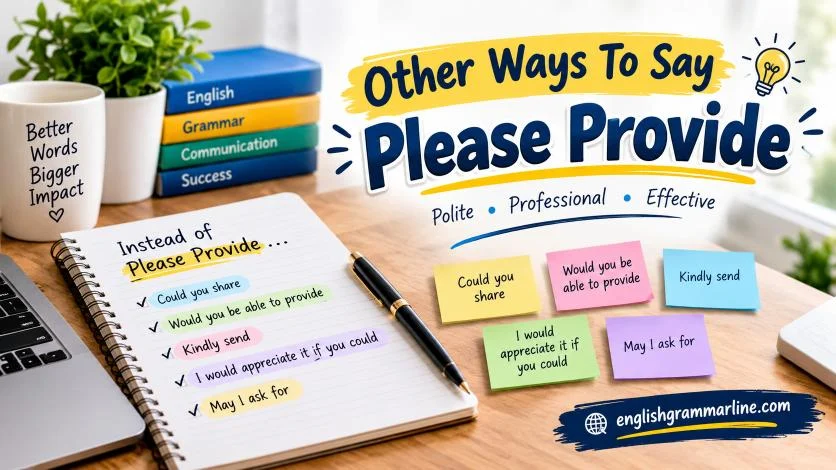
When you need someone to give you information, a document, a file, or another item, please provide is a common phrase to use. It is polite, clear, and useful in many situations. However, using the same phrase repeatedly can make your English sound less natural or repetitive.
Learning other ways to say please provide gives you more choices. You can sound formal in a business email, friendly in a message, or direct when giving instructions. The right expression also makes your meaning easier to understand.
For example, Please provide the requested documents sounds formal and professional. Could you send me the documents? sounds softer and more natural in everyday workplace communication.
Knowing different synonyms for please provide can improve your emails, meetings, academic writing, customer service messages, and daily conversations. The key is choosing an expression that matches the person, purpose, and level of formality.
What Does Please Provide Mean?
Please provide is a polite phrase used to ask someone to give, send, supply, or share something that is needed.
The word provide is a verb. It means to give something that another person needs or requests. It is often followed by an object.
For example:
- Please provide your contact details.
- Please provide a copy of the receipt.
The phrase is usually polite and professional. However, its tone can change depending on the words around it.
Please provide the report sounds direct and formal.
Could you please provide the report? sounds softer.
Can you send me the report? sounds more conversational.
The phrase is especially common in business English, customer service, official forms, applications, school communication, and professional emails.
Some common alternatives to please provide include please send, could you share, please supply, would you mind sending, please submit, and could you provide.
When to Use Please Provide
Spoken English
In spoken English, please provide is useful when asking for information or something specific. However, it can sound more formal than natural conversation.
For example:
Please provide your address before we continue.
In a casual conversation, a speaker may simply say:
Can you give me your address?
Business English
Business communication is one of the best places to use please provide. It is clear and professional.
For example:
Please provide the updated sales figures by Friday.
The phrase works well when requesting reports, information, documents, records, details, or confirmation.
Emails and Messages
Please provide is very common in professional emails. It makes a request clear without sounding rude.
For example:
Please provide the information requested below at your earliest convenience.
For a warmer email, you can use Could you please send or Would you be able to share.
Social Media
The phrase is less common in casual social media conversations. It may sound official or businesslike.
Instead, you might say:
Can you share the link?
or
Could you send me the details?
Academic Writing
Provide is widely used in academic English. It works especially well when asking for evidence, examples, explanations, or supporting information.
For example:
The study should provide evidence to support this conclusion.
Academic writing often prefers provide because it is precise and neutral.
Professional Meetings
During meetings, you can use please provide when requesting information from a colleague.
For example:
Could you please provide an update on the project?
In a meeting, could you provide often sounds more natural than giving a direct command.
Is Please Provide Polite or Professional?
Please provide is generally polite, neutral, and professional.
It is not normally rude. However, the exact wording can affect how strong the request feels.
Polite: Please provide the requested information.
Soft: Could you please provide the information?
Very soft: Would you be able to provide the information?
Neutral: Can you provide the information?
Direct: Provide the information before the meeting.
The final version can sound like an order because it removes please.
For workplace communication, could you please provide is often an excellent choice. It is clear while still sounding respectful.
Better for workplace: Could you please provide the updated report?
Better for casual conversation: Can you send me the report?
A useful etiquette tip is to consider the relationship. If you are speaking to a customer, manager, client, or new colleague, a softer request can sound more respectful.
Pros & Cons of Using Please Provide
✔ Pros
- Sounds polite
- Works well in professional emails
- Clearly explains what you need
- Suitable for formal communication
- Common in business English
- Useful for requesting documents and information
- Easy for English learners to understand
- Works well in official communication
✘ Cons
- Can sound formal in casual conversation
- May feel repetitive if used too often
- Can sound demanding without softening words
- May feel impersonal in friendly communication
- Sometimes send or share is more natural
- Can sound bureaucratic in casual messages
Quick Alternatives to Please Provide
- Could you provide
- Could you please send
- Please send
- Please share
- Could you share
- Please supply
- Please submit
- Please give me
- Can you provide
- Can you send
- Would you provide
- Would you be able to provide
- Would you mind sending
- Could you forward
- Please forward
- Kindly provide
- Kindly send
- Please furnish
- Please make available
- Could you make available
- Please include
- Please attach
- Please pass along
- Please relay
- Please send over
- Could you send over
- Please share with me
- Could you send me
- Can you share with me
- Please hand over
- Please submit the requested information
- Could you supply
- Would you be able to send
- Please communicate
- Please disclose
- Please present
- Please deliver
- Could you forward me
- Please make sure to send
Could You Please Provide
Phrase: Could you please provide
Meaning: A polite way to ask someone to give you something.
Explanation: This is one of the safest and most useful alternatives to please provide. Adding could you turns the request into a polite question. It sounds professional without being too stiff.
Grammar Note: Polite modal question.
Example Sentence: Could you please provide the latest version of the report?
Best Use: Business emails, workplace conversations, customer service, professional requests.
Worst Use: Very casual conversations where a simpler phrase would sound more natural.
Tone: Polite, professional, soft.
Level: Beginner.
Similarity Score: 10/10
Replaceability Tip: Choose this when you want to keep the original meaning while making the request warmer.
Please Send
Phrase: Please send
Meaning: A polite request for someone to send something.
Explanation: This is more specific than please provide. Use it when the requested item needs to be delivered electronically, by mail, or through a messaging platform.
Grammar Note: Polite verb phrase.
Example Sentence: Please send the completed form by tomorrow.
Best Use: Emails, messages, workplace communication.
Worst Use: When the person must physically hand something to you.
Tone: Neutral, polite, direct.
Level: Beginner.
Similarity Score: 9/10
Replaceability Tip: Use please send when you know that sending is the actual action required.
Please Share
Phrase: Please share
Meaning: A polite request for someone to give you access to information or a file.
Explanation: Share sounds friendly and modern. It is especially common with links, documents, ideas, updates, and digital files.
Grammar Note: Polite verb phrase.
Example Sentence: Please share the meeting notes with the team.
Best Use: Workplace, email, messaging, online communication.
Worst Use: Highly formal situations where provide or submit is more precise.
Tone: Friendly, professional, neutral.
Level: Beginner.
Similarity Score: 9/10
Replaceability Tip: Choose this when the item is digital or when you want a collaborative tone.
Could You Share
Phrase: Could you share
Meaning: A polite question asking someone to give or send information.
Explanation: This expression sounds natural and respectful. It is softer than a direct command.
Grammar Note: Modal question.
Example Sentence: Could you share the presentation with me?
Best Use: Emails, meetings, workplace chats.
Worst Use: Official requests where a formal submission is required.
Tone: Polite, friendly, professional.
Level: Beginner.
Similarity Score: 9/10
Replaceability Tip: Use it when you want your request to sound cooperative rather than demanding.
Please Supply
Phrase: Please supply
Meaning: A formal way to ask someone to give or provide something.
Explanation: Supply often suggests giving something that is needed for a particular purpose. It is common in business and official communication.
Grammar Note: Formal verb phrase.
Example Sentence: Please supply the required documentation before processing begins.
Best Use: Business, official documents, formal requests.
Worst Use: Friendly conversations.
Tone: Formal, professional, direct.
Level: Intermediate.
Similarity Score: 9/10
Replaceability Tip: Use it when the requested item is required as part of a process.
Please Submit
Phrase: Please submit
Meaning: A request to officially send something for review or approval.
Explanation: This phrase is more specific than provide. It is ideal when documents, applications, assignments, or forms need to be officially handed in.
Grammar Note: Formal verb phrase.
Example Sentence: Please submit your application before the deadline.
Best Use: Academic, workplace, government, applications.
Worst Use: Casual requests for simple information.
Tone: Formal, professional, direct.
Level: Beginner.
Similarity Score: 8/10
Replaceability Tip: Use submit when the person needs to send something through an official process.
Can You Provide
Phrase: Can you provide
Meaning: A straightforward way to ask someone to give you something.
Explanation: This is common in spoken English and workplace communication. It is slightly less formal than could you provide.
Grammar Note: Modal question.
Example Sentence: Can you provide more details about the issue?
Best Use: Spoken English, workplace, casual professional communication.
Worst Use: Very formal correspondence where a softer phrase is preferred.
Tone: Neutral, polite, direct.
Level: Beginner.
Similarity Score: 10/10
Replaceability Tip: Choose it when you want a simple and natural request.
Would You Be Able to Provide
Phrase: Would you be able to provide
Meaning: A very polite way to ask whether someone can give you something.
Explanation: This phrase is softer than can you provide. It avoids sounding like an order and is useful when asking someone who may be busy.
Grammar Note: Polite modal construction.
Example Sentence: Would you be able to provide a copy of the agreement?
Best Use: Professional emails, clients, managers, formal requests.
Worst Use: Very casual messages.
Tone: Soft, polite, professional.
Level: Intermediate.
Similarity Score: 10/10
Replaceability Tip: Use it when you want maximum politeness without sounding overly formal.
Would You Mind Sending
Phrase: Would you mind sending
Meaning: A polite way to ask someone to send something.
Explanation: This phrase is friendly and respectful. It is especially useful when you are asking someone to do a small favor.
Grammar Note: Polite question followed by a gerund.
Example Sentence: Would you mind sending me the invoice again?
Best Use: Emails, workplace messages, everyday professional communication.
Worst Use: Urgent situations where you need a direct request.
Tone: Very polite, soft, friendly.
Level: Intermediate.
Similarity Score: 9/10
Replaceability Tip: Choose it when your request is a favor rather than a formal requirement.
Kindly Provide
Phrase: Kindly provide
Meaning: A formal and polite request for something.
Explanation: This expression is common in formal business communication, especially in international English. It sounds respectful but can sometimes feel stiff.
Grammar Note: Formal adverb plus verb.
Example Sentence: Kindly provide the required information at your earliest convenience.
Best Use: Formal emails, official communication, business letters.
Worst Use: Casual chats.
Tone: Formal, polite, professional.
Level: Intermediate.
Similarity Score: 10/10
Replaceability Tip: Use it for formal requests when a professional tone is important.
Kindly Send
Phrase: Kindly send
Meaning: A polite request for someone to send something.
Explanation: This is similar to kindly provide, but it focuses on sending. It is often seen in business emails.
Grammar Note: Formal verb phrase.
Example Sentence: Kindly send the signed agreement when convenient.
Best Use: Formal emails and business communication.
Worst Use: Friendly conversations.
Tone: Formal, polite, professional.
Level: Intermediate.
Similarity Score: 9/10
Replaceability Tip: Use it when you want a formal alternative to please send.
Please Furnish
Phrase: Please furnish
Meaning: A highly formal way to ask someone to provide information or documents.
Explanation: Furnish has a formal or legal feeling. It is useful in official writing but may sound old-fashioned in everyday English.
Grammar Note: Formal verb.
Example Sentence: Please furnish the requested records for review.
Best Use: Legal, official, formal business communication.
Worst Use: Casual messages and friendly emails.
Tone: Very formal, official.
Level: Advanced.
Similarity Score: 9/10
Replaceability Tip: Use this only when the setting calls for formal language.
Please Make Available
Phrase: Please make available
Meaning: A request to make something accessible to another person.
Explanation: This phrase is useful when the person is not simply giving you an item but making it accessible for use.
Grammar Note: Formal verb phrase.
Example Sentence: Please make the relevant files available to the team.
Best Use: Workplace, business, technology, professional communication.
Worst Use: Simple personal requests where send is clearer.
Tone: Professional, formal, neutral.
Level: Intermediate.
Similarity Score: 8/10
Replaceability Tip: Use it when access matters more than physically sending something.
Could You Make Available
Phrase: Could you make available
Meaning: A polite request for someone to provide access to something.
Explanation: This is softer than please make available. It is useful for documents, resources, records, files, and information.
Grammar Note: Modal question.
Example Sentence: Could you make the meeting recording available to the team?
Best Use: Workplace, email, professional communication.
Worst Use: Very simple requests where could you send would be clearer.
Tone: Polite, professional, soft.
Level: Intermediate.
Similarity Score: 8/10
Replaceability Tip: Choose it when the other person needs to give access rather than directly send an item.
Please Forward
Phrase: Please forward
Meaning: A request to send something that was received elsewhere.
Explanation: This phrase is especially useful for emails, messages, documents, or information that someone already has.
Grammar Note: Phrasal verb.
Example Sentence: Please forward the email to the finance department.
Best Use: Workplace, email, professional communication.
Worst Use: When the requested item has not been received yet.
Tone: Neutral, professional, direct.
Level: Beginner.
Similarity Score: 8/10
Replaceability Tip: Use forward when the person is passing something from one recipient to another.
Please Include
Phrase: Please include
Meaning: A request to add something to a document, message, or submission.
Explanation: This is not a complete synonym for provide, but it works when the request means give this information as part of something else.
Grammar Note: Imperative verb phrase.
Example Sentence: Please include your phone number on the application form.
Best Use: Forms, emails, applications, reports.
Worst Use: When you want someone to send a separate document.
Tone: Polite, direct, professional.
Level: Beginner.
Similarity Score: 7/10
Replaceability Tip: Use it when the information needs to be added rather than sent separately.
Please Attach
Phrase: Please attach
Meaning: A request to add a file to an email or digital message.
Explanation: This is a very useful modern alternative when requesting documents electronically.
Grammar Note: Imperative verb phrase.
Example Sentence: Please attach a copy of your identification document.
Best Use: Emails, applications, workplace communication.
Worst Use: When the document needs to be physically delivered.
Tone: Neutral, professional, direct.
Level: Beginner.
Similarity Score: 7/10
Replaceability Tip: Choose please attach when the requested item is an electronic file.
Mini Dialogue Examples
Formal Conversation
Manager: We need the final documents before the review.
Employee: I have completed most of them.
Manager: Thank you. Could you please provide the remaining documents by Thursday?
Employee: Certainly. I will send them this afternoon.
Informal Conversation
Friend: Do you still have that travel plan?
Friend: Yes, I do.
Friend: Great. Can you send it to me?
Friend: Sure, I’ll send it now.
Business Email Style
Dear Mr. Adams,
Thank you for your message.
Could you please provide the updated sales figures and the revised report? This will allow us to complete the review before the next meeting.
Thank you for your assistance.
Best regards,
Daniel
Mistakes to Avoid
Using Please Provide for Everything
Do not use please provide when another verb is more accurate.
If you need an email, use please forward.
If you need a file, use please attach.
If you need an application, use please submit.
Sounding Too Formal
Using please furnish with a close friend can sound unnatural. Choose language that matches the relationship.
Forgetting the Object
Saying please provide without explaining what you need can create confusion.
Instead of:
Please provide.
Say:
Please provide the updated report.
Making a Request Sound Like an Order
Provide the document immediately sounds strong.
A softer option is:
Could you please provide the document when you have a chance?
Using Send When Provide Is Better
Send means deliver something from one place or person to another. Provide has a broader meaning.
For example, you can provide information, but you would usually send a document.
Using Submit Incorrectly
Submit usually suggests an official process. Do not use it for every normal request.
Overusing Kindly
Kindly can be professional, but repeating it in every email can make your writing sound stiff. Use it when the situation calls for a formal tone.
Cultural & Tone Tips
Native English speakers usually understand please provide as polite and professional. The phrase is common in business settings because it is clear and efficient.
In UK English, phrases such as could you please provide and would you be able to send are often used to make requests softer.
In US English, can you send, could you send, and can you share are very common in workplace communication.
In casual social English, people usually prefer simpler expressions such as can you send me, could you share, or can you give me.
The word please does not automatically make every sentence sound friendly. The complete sentence matters. For example, Please send this immediately is polite in form but still sounds urgent and commanding.
A useful rule is:
Formal situation: Please provide the requested information.
Professional but warm: Could you please send the information?
Casual: Can you send me the information?
Very casual: Can you send that over?
Choosing the right level helps your English sound natural instead of overly formal.
Comparison Table
| Phrase | Tone | Best Context | Professional Level | Example |
|---|---|---|---|---|
| Could you please provide | Polite | Business emails | Very high | Could you please provide the report? |
| Please send | Neutral | Emails | High | Please send the document today. |
| Please share | Friendly | Workplace | High | Please share the updated file. |
| Would you be able to provide | Soft | Formal requests | Very high | Would you be able to provide a copy? |
| Please submit | Formal | Applications | Very high | Please submit the completed form. |
| Could you share | Friendly | Meetings and messages | High | Could you share the presentation? |
| Please furnish | Very formal | Legal writing | Very high | Please furnish the requested records. |
FAQs
Is Please Provide Rude?
No. Please provide is generally polite. However, it is more formal than phrases such as can you send or could you share. The rest of the sentence can make the request sound softer or stronger.
Is Please Provide Okay in Emails?
Yes. Please provide is excellent for professional emails. It is especially useful when requesting documents, information, reports, details, or records.
For a softer tone, use could you please provide or would you be able to provide.
What Is the Most Formal Alternative to Please Provide?
Please furnish is one of the most formal options. It is often associated with legal, official, or highly formal writing.
For most business emails, however, could you please provide is more natural.
What Is the Most Polite Alternative to Please Provide?
Would you be able to provide is a very polite option. It sounds respectful because it asks about the person’s ability rather than directly telling them what to do.
What Should Beginners Use Instead of Please Provide?
Beginners can use please send, please share, can you provide, and could you please provide.
These expressions are common, easy to understand, and useful in many situations.
Is Could You Please Provide Better Than Please Provide?
It depends on the situation. Please provide is clear and professional. Could you please provide sounds softer and more conversational.
For a polite workplace request, could you please provide is often the better choice.
Conclusion:
Learning other ways to say please provide gives you more control over your English. Instead of using one phrase for every situation, you can choose words that match your purpose and audience.
Use please provide for clear professional requests. Choose could you please provide when you want a softer tone. Use please send for files and documents, please share for digital information, and please submit for official applications or forms.
These alternatives to please provide can make your emails, conversations, and workplace communication sound more natural. Practice them in real situations, and soon you will know which expression feels right for each context.

I’m John Mark, the creator of EnglishGrammarline. I share simple and meaningful insights into dreams, their symbols, and possible interpretations. My goal is to help readers understand their dreams in an easy and interesting way.