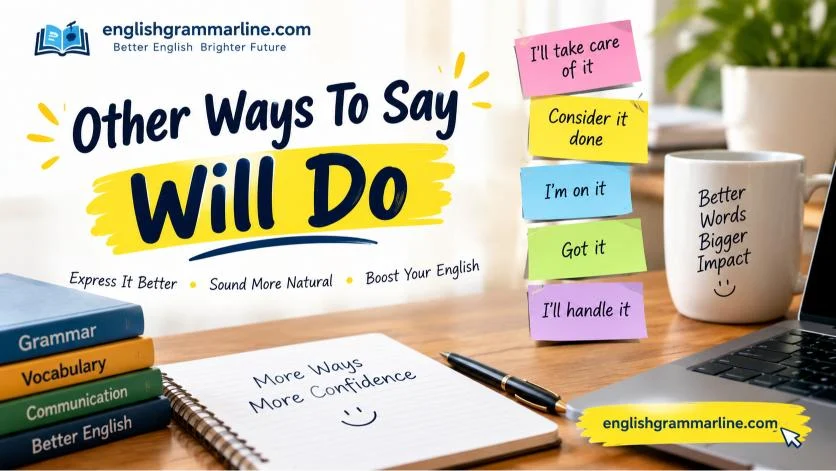
Will do is a short and useful English expression that means I will do it, I will take care of it, or I will complete the task. People often use it when they agree to a request or want to confirm that they understand what needs to be done.
Although will do is common, it can sometimes sound too brief or casual. Knowing different ways to say it helps you match your words to the situation. This is especially useful when writing emails, speaking at work, replying to a manager, talking with friends, or communicating with customers.
For example, Will do! sounds friendly and casual, while I will take care of it sounds more professional.
Learning other ways to say will do gives English learners more choices. It also helps make conversations clearer, more natural, and more confident.
What Does Will Do Mean?
Will do is a short expression used to show that you agree to complete a task, follow an instruction, or handle a request.
It is often used as a reply.
For example:
- Please send me the report today.
- Will do.
Here, will do means I will send the report.
The expression comes from the future form will plus the verb do. In everyday conversation, the rest of the sentence is understood from the context.
The complete idea might be:
I will do that.
But English speakers often shorten it to:
Will do.
It is usually informal to neutral. It is common in texts, chats, workplace conversations, and quick spoken replies. However, it may sound too brief for some formal emails.
Useful synonyms and related expressions include:
- I will
- I will take care of it
- Consider it done
- I will handle it
- Absolutely
- Sure, I can do that
- I will get it done
- I will take care of this
- Understood
- Got it
The best alternative depends on the tone and situation.
When to Use Will Do
Spoken English
Will do is very common in spoken English. It works when someone gives you a simple instruction or request.
For example:
Please remember to lock the door.
Will do.
It is quick, natural, and easy to understand.
Business English
In business settings, will do can work in casual conversations with coworkers. However, a more complete response may sound better when speaking with clients, senior managers, or new business contacts.
Instead of:
Will do.
You could say:
I will take care of it.
This sounds more professional and reassuring.
Emails and Messages
The expression is common in workplace messages and quick email replies.
For example:
Can you update the spreadsheet before the meeting?
Will do.
For a formal email, consider a fuller response such as:
Certainly. I will take care of the update.
Social Media
Will do works well on social media and messaging apps. It is short and conversational.
For example:
Send me the details when you can.
Will do!
It can also be used with emojis or an exclamation mark when the conversation is friendly.
Academic Writing
Will do is usually too conversational for formal academic writing. Academic writing generally requires complete sentences and a more objective style.
Instead, use expressions such as:
The requested changes will be completed.
or
I will make the necessary revisions.
Professional Meetings
In meetings, will do can be useful when responding quickly to an instruction.
For example:
Please share the final figures with the finance team.
Will do.
However, when the task is important, a clearer response can be better:
Certainly. I will send the final figures this afternoon.
Is Will Do Polite or Professional?
Will do is generally polite, but its level of professionalism depends on the context.
It is usually:
- Friendly in casual conversations
- Neutral in everyday workplace communication
- Professional enough for quick internal messages
- Less formal in client communication
- Too casual for some official correspondence
The expression is not normally rude. Its shortness is what can sometimes make it feel abrupt.
For example:
Manager: Please send the report by noon.
Employee: Will do.
This sounds perfectly normal.
But:
Client: Please confirm the contract details.
Reply: Will do.
This may sound a little too casual. A better response would be:
Certainly. I will confirm the contract details shortly.
Better for workplace: I will take care of it.
Better for casual conversation: Will do.
Better for formal emails: Certainly, I will handle this.
Pros & Cons of Using Will Do
✔ Pros
- Short and easy to use
- Shows agreement
- Confirms that you understood a request
- Sounds natural in conversation
- Works well in text messages
- Useful for quick workplace replies
- Friendly and positive
- Easy for English learners
✘ Cons
- Can sound too brief
- May feel casual in formal emails
- Does not explain exactly what you will do
- Can sound abrupt without context
- May not be ideal for customer communication
- Can become repetitive
- Sometimes sounds less professional than a complete sentence
Quick Alternatives to Will Do
- I will
- I will do that
- I will take care of it
- I will handle it
- Certainly
- Absolutely
- Sure, I can do that
- Consider it done
- I have it covered
- I will get it done
- I will take care of this
- Understood
- Got it
- No problem
- I will see to it
- I will make it happen
- I can take care of that
- Leave it with me
- I am on it
- I will get right on it
I Will
Phrase: I will
Meaning: A direct way to promise or confirm that you will complete something.
Explanation: I will is one of the simplest and safest alternatives to will do. It sounds slightly more complete because it includes the subject. It can work in both casual and professional conversations.
Grammar Note: Future modal construction.
Example Sentence: I will send the document this afternoon.
Best Use: Workplace, emails, conversations, professional messages.
Worst Use: Situations where you need to explain what action you will take but provide no details.
Tone: Neutral, professional, clear.
Level: Beginner.
Similarity Score: 10/10
Replaceability Tip: Choose I will when you want a simple but slightly more complete response.
I Will Do That
Phrase: I will do that
Meaning: A clear confirmation that you agree to complete a specific task.
Explanation: This expression makes the meaning of will do more explicit. It is useful for learners because there is little room for confusion.
Grammar Note: Future tense sentence.
Example Sentence: Please remind Sarah about the meeting.
I will do that.
Best Use: Spoken English, messages, workplace communication.
Worst Use: Very formal writing where a more specific statement would be better.
Tone: Neutral, polite, clear.
Level: Beginner.
Similarity Score: 10/10
Replaceability Tip: Use this when you want to make your agreement completely clear.
I Will Take Care of It
Phrase: I will take care of it
Meaning: I will handle the task or problem.
Explanation: This is one of the best professional alternatives to will do. It reassures the listener that you accept responsibility.
Grammar Note: Idiomatic verb phrase.
Example Sentence: Thanks for letting me know. I will take care of it.
Best Use: Workplace, customer service, business emails, professional conversations.
Worst Use: When you are not actually responsible for the task.
Tone: Professional, reassuring, confident.
Level: Intermediate.
Similarity Score: 10/10
Replaceability Tip: Use it when you want to sound responsible and dependable.
I Will Handle It
Phrase: I will handle it
Meaning: I will manage or deal with the situation.
Explanation: This expression shows confidence and responsibility. It is especially useful when someone has asked you to deal with a problem.
Grammar Note: Verb phrase.
Example Sentence: There is an issue with the order, but I will handle it.
Best Use: Workplace, business, customer service, conversations.
Worst Use: When the situation requires teamwork and saying this may suggest that others should stay out.
Tone: Confident, professional, strong.
Level: Intermediate.
Similarity Score: 9/10
Replaceability Tip: Choose this when you want to emphasize that you are responsible for the task.
Certainly
Phrase: Certainly
Meaning: Yes, definitely, or of course.
Explanation: Certainly can replace will do when you want to give a polite and professional confirmation. It is especially useful in customer service and formal communication.
Grammar Note: Adverb used as a response.
Example Sentence: Could you send me the updated file?
Certainly.
Best Use: Professional emails, customer service, formal conversations.
Worst Use: Very casual conversations where it may sound overly formal.
Tone: Polite, formal, professional.
Level: Intermediate.
Similarity Score: 8/10
Replaceability Tip: Use certainly when your main goal is to express polite agreement.
Absolutely
Phrase: Absolutely
Meaning: Definitely or yes, without doubt.
Explanation: This expression shows strong agreement. It sounds more enthusiastic than will do.
Grammar Note: Adverb used independently.
Example Sentence: Can you help me prepare the presentation?
Absolutely.
Best Use: Conversations, workplace communication, friendly professional settings.
Worst Use: Highly formal documents.
Tone: Positive, confident, enthusiastic.
Level: Beginner.
Similarity Score: 8/10
Replaceability Tip: Choose it when you want to sound enthusiastic rather than simply compliant.
Sure, I Can Do That
Phrase: Sure, I can do that
Meaning: Yes, I am willing and able to complete the task.
Explanation: This is a natural everyday alternative. It clearly shows agreement while sounding friendly.
Grammar Note: Modal verb phrase.
Example Sentence: Could you pick up the documents?
Sure, I can do that.
Best Use: Spoken English, messages, casual workplace communication.
Worst Use: Very formal business correspondence.
Tone: Friendly, polite, natural.
Level: Beginner.
Similarity Score: 9/10
Replaceability Tip: Use this when you want a warmer and clearer version of will do.
Consider It Done
Phrase: Consider it done
Meaning: You can trust that I will complete the task.
Explanation: This is a confident idiomatic expression. It gives strong reassurance and can sound energetic.
Grammar Note: Idiomatic expression.
Example Sentence: Please make sure the room is ready by six.
Consider it done.
Best Use: Informal workplace conversations, friendly business communication.
Worst Use: Very formal documents or sensitive situations requiring careful wording.
Tone: Confident, friendly, strong.
Level: Intermediate.
Similarity Score: 10/10
Replaceability Tip: Use this when you want to sound highly confident about completing a request.
I Have It Covered
Phrase: I have it covered
Meaning: I am already taking care of the situation.
Explanation: This expression reassures someone that they do not need to worry. It is more conversational than will do.
Grammar Note: Idiomatic phrase.
Example Sentence: Don’t worry about the decorations. I have it covered.
Best Use: Casual conversations, teamwork, informal workplace settings.
Worst Use: Formal customer emails.
Tone: Friendly, confident, reassuring.
Level: Intermediate.
Similarity Score: 8/10
Replaceability Tip: Choose this when someone is worried about whether a task will be handled.
I Will Get It Done
Phrase: I will get it done
Meaning: I promise to complete the task.
Explanation: This phrase shows determination. It is stronger than a simple will do because it focuses on completion.
Grammar Note: Future tense with phrasal verb.
Example Sentence: The deadline is tight, but I will get it done.
Best Use: Workplace, motivational conversations, teamwork.
Worst Use: Situations where making a firm promise could be risky.
Tone: Determined, confident, professional.
Level: Intermediate.
Similarity Score: 9/10
Replaceability Tip: Use it when you want to emphasize commitment and results.
I Will Take Care of This
Phrase: I will take care of this
Meaning: I will handle the specific matter being discussed.
Explanation: This is a polished workplace alternative. The word this points directly to the task or issue.
Grammar Note: Idiomatic verb phrase.
Example Sentence: I noticed the error in the report. I will take care of this.
Best Use: Workplace, professional emails, customer communication.
Worst Use: Casual situations where I will handle it may sound more natural.
Tone: Professional, calm, reassuring.
Level: Intermediate.
Similarity Score: 10/10
Replaceability Tip: Choose this when you want to sound responsible without being overly formal.
Understood
Phrase: Understood
Meaning: I understand the instruction or request.
Explanation: Understood confirms comprehension rather than directly promising action. It can work as an alternative when the context already makes the next action obvious.
Grammar Note: Past participle used independently.
Example Sentence: Please keep the information confidential.
Understood.
Best Use: Workplace, professional conversations, instructions.
Worst Use: Friendly conversations where it may sound too serious.
Tone: Neutral, formal, serious.
Level: Beginner.
Similarity Score: 7/10
Replaceability Tip: Use it when the important point is that you received and understood an instruction.
Got It
Phrase: Got it
Meaning: I understand, and I will act accordingly.
Explanation: This is one of the most common casual alternatives. It is short, natural, and friendly.
Grammar Note: Informal conversational expression.
Example Sentence: Please call me after the meeting.
Got it.
Best Use: Text messages, casual conversations, friendly workplace chats.
Worst Use: Formal business letters.
Tone: Casual, friendly, neutral.
Level: Beginner.
Similarity Score: 8/10
Replaceability Tip: Use it when you want to confirm understanding in a relaxed way.
No Problem
Phrase: No problem
Meaning: I am happy to do it or it will not be difficult.
Explanation: This phrase is often used to accept a request. It sounds friendly and relaxed.
Grammar Note: Conversational phrase.
Example Sentence: Could you send me the link?
No problem.
Best Use: Everyday speech, messages, informal workplace communication.
Worst Use: Highly formal communication where a more professional response is preferred.
Tone: Friendly, casual, reassuring.
Level: Beginner.
Similarity Score: 8/10
Replaceability Tip: Use it when you want to make your response warm and easygoing.
I Will See to It
Phrase: I will see to it
Meaning: I will make sure the task is handled.
Explanation: This is a more formal expression. It shows responsibility and is useful when you want to sound careful and professional.
Grammar Note: Idiomatic verb phrase.
Example Sentence: I will see to it that the documents are delivered on time.
Best Use: Formal workplace communication, professional conversations.
Worst Use: Casual text messages.
Tone: Formal, professional, responsible.
Level: Advanced.
Similarity Score: 9/10
Replaceability Tip: Choose this when you want a polished alternative that emphasizes responsibility.
I Will Make It Happen
Phrase: I will make it happen
Meaning: I will work to ensure the desired result happens.
Explanation: This is stronger than will do. It shows determination and confidence.
Grammar Note: Idiomatic verb phrase.
Example Sentence: We need the event ready by Friday, and I will make it happen.
Best Use: Teamwork, leadership, motivational workplace conversations.
Worst Use: Formal documents where the expression may sound too personal or dramatic.
Tone: Strong, confident, motivating.
Level: Intermediate.
Similarity Score: 8/10
Replaceability Tip: Use it when you want to emphasize determination rather than simple agreement.
I Can Take Care of That
Phrase: I can take care of that
Meaning: I am able and willing to handle the task.
Explanation: This is a friendly professional expression. It is especially useful when someone asks who can handle a particular job.
Grammar Note: Modal verb plus idiomatic phrase.
Example Sentence: Someone needs to contact the supplier.
I can take care of that.
Best Use: Workplace, teamwork, emails, professional conversations.
Worst Use: Situations where you are not actually available to do the task.
Tone: Helpful, professional, friendly.
Level: Intermediate.
Similarity Score: 9/10
Replaceability Tip: Use it when volunteering to take responsibility for something.
Leave It With Me
Phrase: Leave it with me
Meaning: I will take responsibility for it.
Explanation: This expression is natural and reassuring. It is especially common in British English and professional conversations.
Grammar Note: Idiomatic phrase.
Example Sentence: I’ll check the figures and get back to you. Leave it with me.
Best Use: Workplace conversations, British English, customer service.
Worst Use: Highly formal writing.
Tone: Friendly, confident, reassuring.
Level: Intermediate.
Similarity Score: 9/10
Replaceability Tip: Choose this when you want to reassure someone that you will handle something.
I Am on It
Phrase: I am on it
Meaning: I am already working on the task.
Explanation: This phrase is common in modern workplace English. It suggests that action has already started.
Grammar Note: Informal idiomatic phrase.
Example Sentence: Can you fix the issue with the website?
I am on it.
Best Use: Workplace chats, messages, casual professional communication.
Worst Use: Formal client emails.
Tone: Casual, confident, energetic.
Level: Intermediate.
Similarity Score: 9/10
Replaceability Tip: Use this when you have already started dealing with the request.
I Will Get Right on It
Phrase: I will get right on it
Meaning: I will start working on it immediately.
Explanation: This expression adds urgency and enthusiasm. It tells the listener that you will not delay.
Grammar Note: Idiomatic phrasal expression.
Example Sentence: Please check the customer’s account.
I will get right on it.
Best Use: Workplace conversations, messages, informal professional settings.
Worst Use: Formal reports and academic writing.
Tone: Energetic, helpful, confident.
Level: Intermediate.
Similarity Score: 9/10
Replaceability Tip: Choose it when speed matters and you want to show immediate action.
Mini Dialogue Examples
Formal Dialogue
Supervisor: Could you review the final document before it goes to the client?
Employee: Certainly. I will take care of it and send you the revised version.
Supervisor: Thank you.
Informal Dialogue
Friend: Can you bring some snacks for the trip?
Friend: Sure.
Friend: Will do!
Business Email Style
Subject: Updated Report
Dear James,
Thank you for the reminder. I will take care of the requested changes and send the updated report by the end of the day.
Best regards,
Michael
Mistakes to Avoid
- Using will do in every situation: The phrase is useful, but different situations need different levels of formality.
- Using it in formal emails: A complete sentence often sounds more professional.
- Confusing understanding with agreement: Understood means you understand, while I will take care of it clearly promises action.
- Being too brief with clients: A one-word response may not provide enough reassurance.
- Using strong expressions unnecessarily: I will make it happen can sound overly forceful for a simple request.
- Making promises you cannot keep: Expressions such as consider it done sound very confident, so use them only when you can deliver.
- Ignoring the relationship: The best response to a close friend may not be the best response to a manager or customer.
Cultural & Tone Tips
Native English speakers usually understand will do as a quick confirmation. It often sounds friendly and cooperative.
In US English, will do, got it, sure, and I am on it are common in informal workplace communication.
In UK English, will do, leave it with me, and I will see to it can all be heard, although their formality differs.
In casual social English, people often choose very short replies:
Sure.
Got it.
No problem.
Will do.
In professional settings, a complete response may be more reassuring:
I will take care of it and keep you updated.
Tone also depends on punctuation. Will do! feels warmer and more enthusiastic. Will do. feels more neutral and direct.
If you are unsure, choose a slightly fuller phrase. I will take care of it is a safe professional option in many workplace situations.
Best Alternatives at a Glance
| Phrase | Tone | Best Context | Professional Level | Example |
|---|---|---|---|---|
| I will take care of it | Professional | Workplace | High | I will take care of it today. |
| I will handle it | Confident | Business | High | I will handle the issue. |
| Certainly | Formal | Client communication | Very high | Certainly, I will review it. |
| Consider it done | Confident | Informal workplace | Medium | Consider it done. |
| Got it | Casual | Messages | Medium | Got it, I will send it soon. |
| I am on it | Energetic | Workplace chats | Medium | I am on it right now. |
| I will see to it | Formal | Professional communication | Very high | I will see to it immediately. |
FAQs
Is Will Do Rude?
No. Will do is not normally rude. It is a short and friendly way to confirm that you will complete a task. However, it can sound too brief in some formal situations.
Is Will Do Okay in Emails?
Yes, especially in casual workplace emails and internal messages. For clients, managers, or formal correspondence, I will take care of it or Certainly, I will handle this may sound more polished.
What Is the Most Professional Alternative to Will Do?
I will take care of it is one of the best professional alternatives. It sounds clear, responsible, and reassuring.
What Is the Most Polite Alternative to Will Do?
Certainly, I will take care of it is a very polite option. It works well when speaking with customers, clients, managers, or other professional contacts.
What Should Beginners Use Instead of Will Do?
Beginners can use I will, I will do that, sure, I can do that, and I will take care of it. These phrases are simple and easy to understand.
Is Consider It Done the Same as Will Do?
The meanings are very similar, but consider it done is stronger and more confident. It suggests that the speaker is very sure the task will be completed.
Conclusion:
Learning other ways to say will do gives you more control over your English. While will do is short, natural, and useful, it may not fit every situation. In casual conversations, got it, no problem, and sure, I can do that sound friendly. At work, I will take care of it, I will handle it, and I can take care of that sound more professional.
Using different expressions helps you match your tone to the listener. It also makes your English sound more natural and flexible. Practice these alternatives in real conversations, workplace messages, and emails. Over time, choosing the right expression will become much easier.

I’m John Mark, the creator of EnglishGrammarline. I share simple and meaningful insights into dreams, their symbols, and possible interpretations. My goal is to help readers understand their dreams in an easy and interesting way.