
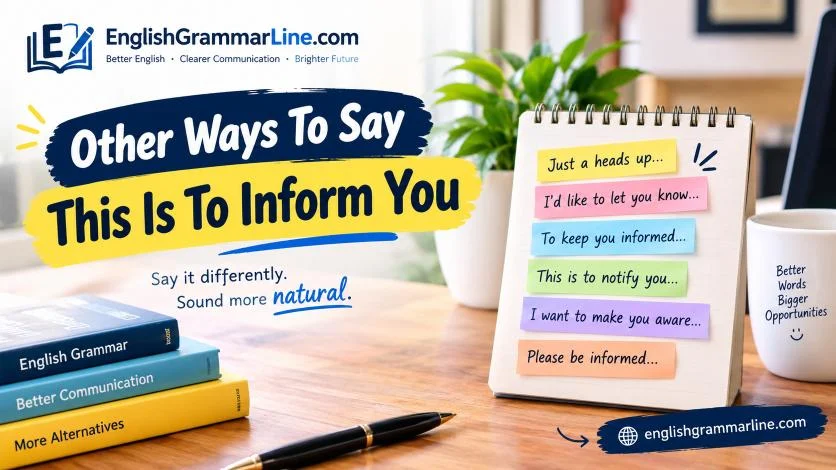
This is to inform you is a formal phrase used to share information, give an update, or make someone aware of something. You often see it in business emails, official notices, workplace messages, and professional letters. While the phrase is correct, using it too often can make your writing sound repetitive or overly formal.
Learning other ways to say this is to inform you gives you more choices. You can select words that match your audience, purpose, and relationship with the reader. Some alternatives sound highly professional, while others are warmer and more natural.
For example, This is to inform you that your request has been approved sounds formal. A simpler option is We are pleased to let you know that your request has been approved.
Using different expressions can make emails, announcements, academic writing, and everyday communication clearer and more engaging. The key is to choose an expression that sounds natural for the situation.
What Does This Is to Inform You Mean?
This is to inform you means I am telling you something important or making you aware of some information.
It is a formal introductory phrase. It is often followed by that and a complete statement.
For example:
- This is to inform you that the meeting has been postponed.
- This is to inform you that your application was successful.
The phrase contains inform, which is a verb meaning to give someone information or knowledge about something.
Grammar Form
This is to inform you is a formal sentence structure containing:
- This — pronoun
- is — verb
- to inform — infinitive verb
- you — object pronoun
It is usually used in formal written communication.
Common synonyms and alternatives include:
- We would like to inform you
- Please be advised
- We wish to inform you
- We are writing to let you know
- We would like to let you know
- Please note that
- Kindly note that
- We are pleased to announce
- We would like to bring to your attention
- I wanted to let you know
The opposite idea would be expressions such as please disregard, there is no need to be aware of this, or simply not communicating the information.
When to Use This Is to Inform You
Spoken English
This is to inform you is grammatically correct in speech, but it can sound unusually formal.
In everyday conversation, native speakers are more likely to say:
I just wanted to let you know that the meeting has changed.
Or:
I wanted to tell you about the change.
Use the original phrase in spoken English only when the situation itself is formal, such as an official announcement.
Business English
This phrase is common in business communication. It can introduce an important update, decision, policy, or announcement.
For example:
This is to inform you that the office will remain closed on Monday.
However, modern business writing often favors more direct and natural alternatives such as We would like to let you know.
Emails and Messages
The phrase can be used in formal emails, especially when communicating an official matter.
For example:
This is to inform you that your account has been updated.
For ordinary workplace emails, however, a warmer alternative may be better:
We wanted to let you know that your account has been updated.
Social Media
The phrase is usually too formal for casual social media posts.
A company making an official announcement might use a similar formal tone, but personal posts usually sound better with expressions such as:
We are excited to share that…
or
We wanted to let you know that…
Academic Writing
Academic writing often requires formal language, but this is to inform you is more common in correspondence than in academic arguments.
For research or essays, direct statements are usually better.
Instead of:
This is to inform you that the study has several limitations.
you could write:
The study has several limitations.
Professional Meetings
In meetings, it is usually more natural to say:
I wanted to let everyone know that…
or
I’d like to let you know that…
The original phrase may sound overly official unless you are making a formal announcement.
Is This Is to Inform You Polite or Professional?
This is to inform you is generally formal, polite, and professional.
It is not normally rude. However, its tone can feel distant or bureaucratic when used in everyday communication.
Polite
The phrase can introduce information in a respectful way.
This is to inform you that your request has been received.
Neutral
A simpler option can sound more natural:
We wanted to let you know that your request has been received.
Strong
For urgent information, you might use:
Please be advised that the deadline has changed.
This sounds more serious.
Soft
A softer alternative is:
We just wanted to let you know that the schedule has changed.
Formal
We wish to inform you that the policy has been updated.
Informal
Just wanted to let you know that the schedule has changed.
Etiquette Tip
Better for workplace: Use We would like to inform you, We wanted to let you know, or Please note that depending on the situation.
Avoid in casual messages: Using This is to inform you with friends or family can sound stiff and unnatural.
Pros and Cons of Using This Is to Inform You
✔ Pros
- Sounds formal and professional
- Clearly introduces important information
- Works well in official notices
- Suitable for business correspondence
- Easy to understand
- Useful for formal announcements
- Creates a serious tone
✘ Cons
- Can sound old-fashioned in some contexts
- May feel impersonal
- Can make simple messages unnecessarily formal
- Is less natural in casual conversation
- May sound repetitive when used in every email
- Modern business writing often prefers more direct language
Quick Alternatives to This Is to Inform You
- We would like to inform you
- We wish to inform you
- Please be advised
- Please note that
- Kindly note that
- We wanted to let you know
- We would like to let you know
- I wanted to let you know
- I am writing to inform you
- We are writing to let you know
- We are pleased to announce
- We are pleased to inform you
- We would like to bring to your attention
- Please be aware that
- This message is to let you know
- I am reaching out to let you know
- I would like to bring to your attention
- We would like to make you aware
- I wanted to make you aware
- Please take note that
We Would Like to Inform You
Meaning: A formal way to tell someone something important.
Explanation: This is one of the closest synonyms for this is to inform you. It sounds professional and respectful. It is especially useful when an organization or company is communicating with customers, employees, or clients.
Grammar Note: Formal verb phrase.
Example Sentence: We would like to inform you that your application has been approved.
Best Use: Business emails, official notices, customer communication, workplace messages.
Worst Use: Casual conversations with close friends.
Tone: Formal, polite, professional.
Level: Intermediate.
Similarity Score: 10/10
Replaceability Tip: Use this when you want almost the same meaning as the original phrase but a more natural formal structure.
We Wish to Inform You
Meaning: We want to formally give you some information.
Explanation: This expression is highly formal and is common in official letters and institutional communication. It has a serious and traditional tone.
Grammar Note: Formal verb phrase.
Example Sentence: We wish to inform you that the office will be closed next Friday.
Best Use: Official letters, formal announcements, institutions.
Worst Use: Casual emails or friendly messages.
Tone: Very formal, serious, professional.
Level: Advanced.
Similarity Score: 10/10
Replaceability Tip: Choose this when your message needs a formal or official tone.
Please Be Advised
Meaning: Please take notice of the information that follows.
Explanation: This phrase is direct and formal. It often introduces important information, warnings, changes, or instructions.
Grammar Note: Formal passive construction.
Example Sentence: Please be advised that the deadline has been extended.
Best Use: Business emails, policies, customer notices, official communication.
Worst Use: Friendly personal messages.
Tone: Formal, serious, direct.
Level: Intermediate.
Similarity Score: 9/10
Replaceability Tip: Use it when the information is important and the reader should pay attention.
Please Note That
Meaning: Please pay attention to the information that follows.
Explanation: This is shorter and more direct than this is to inform you. It works very well when you want to highlight a specific fact.
Grammar Note: Imperative phrase.
Example Sentence: Please note that the office will close at 3 p.m.
Best Use: Emails, notices, instructions, workplace communication.
Worst Use: Very casual conversations.
Tone: Polite, neutral, professional.
Level: Beginner.
Similarity Score: 8/10
Replaceability Tip: Choose this when the main purpose is to make one specific detail clear.
Kindly Note That
Meaning: Please pay attention to the information provided.
Explanation: This is a polite alternative often used in professional communication. It is common in international business English, although some native speakers may prefer the simpler please note.
Grammar Note: Polite imperative phrase.
Example Sentence: Kindly note that all applications must be submitted by Friday.
Best Use: Formal emails, workplace communication, customer service.
Worst Use: Very casual messages.
Tone: Polite, formal, professional.
Level: Intermediate.
Similarity Score: 8/10
Replaceability Tip: Use it when you want to sound courteous while drawing attention to important information.
We Wanted to Let You Know
Meaning: We wanted to give you some information.
Explanation: This is a warm and modern alternative. It sounds much less bureaucratic than this is to inform you while remaining professional.
Grammar Note: Conversational verb phrase.
Example Sentence: We wanted to let you know that your order is ready.
Best Use: Customer emails, workplace messages, general professional communication.
Worst Use: Highly formal legal notices.
Tone: Friendly, polite, professional.
Level: Beginner.
Similarity Score: 9/10
Replaceability Tip: Use this when you want your message to sound natural and approachable.
We Would Like to Let You Know
Meaning: We want to tell you something.
Explanation: This expression balances professionalism and warmth. It is useful when communicating information to customers or colleagues.
Grammar Note: Polite verb phrase.
Example Sentence: We would like to let you know that your payment has been received.
Best Use: Business emails, customer service, workplace communication.
Worst Use: Very casual conversations where we wanted to let you know is easier.
Tone: Polite, professional, warm.
Level: Beginner.
Similarity Score: 9/10
Replaceability Tip: Choose this when you want professional language without sounding too formal.
I Wanted to Let You Know
Meaning: I wanted to tell you something.
Explanation: This is a natural choice when one person is sharing information. It sounds friendly and personal.
Grammar Note: Past-tense conversational phrase.
Example Sentence: I wanted to let you know that the meeting has been moved to Thursday.
Best Use: Emails, messages, workplace conversations, personal communication.
Worst Use: Highly official announcements from an organization.
Tone: Friendly, polite, natural.
Level: Beginner.
Similarity Score: 9/10
Replaceability Tip: Use it when writing to someone you know rather than making an official announcement.
I Am Writing to Inform You
Meaning: I am contacting you to give you important information.
Explanation: This is a formal email and letter opening. It clearly explains the purpose of the message.
Grammar Note: Formal present-progressive construction.
Example Sentence: I am writing to inform you that your appointment has been rescheduled.
Best Use: Formal emails, letters, official correspondence.
Worst Use: Text messages and casual conversations.
Tone: Formal, professional, direct.
Level: Intermediate.
Similarity Score: 10/10
Replaceability Tip: Use this when the main purpose of the email is to formally communicate information.
We Are Writing to Let You Know
Meaning: We are contacting you to share information.
Explanation: This is a more natural version of a traditional formal opening. It is useful for businesses communicating with customers.
Grammar Note: Professional verb phrase.
Example Sentence: We are writing to let you know that your membership will expire soon.
Best Use: Customer emails, company communication, formal notices.
Worst Use: Very casual messages.
Tone: Professional, polite, approachable.
Level: Intermediate.
Similarity Score: 9/10
Replaceability Tip: Use this when you want a professional opening without sounding overly official.
We Are Pleased to Announce
Meaning: We are happy to officially share some news.
Explanation: This expression is best for positive announcements. It adds a feeling of excitement or satisfaction that the original phrase does not always have.
Grammar Note: Formal announcement phrase.
Example Sentence: We are pleased to announce the opening of our new office.
Best Use: Company announcements, newsletters, websites, public communication.
Worst Use: Negative or routine information.
Tone: Formal, positive, celebratory.
Level: Intermediate.
Similarity Score: 7/10
Replaceability Tip: Choose this when you are sharing good news rather than simply giving information.
We Are Pleased to Inform You
Meaning: We are happy to formally tell you something.
Explanation: This is a polished professional phrase. It is especially useful for positive decisions, approvals, successful applications, and good news.
Grammar Note: Formal verb phrase.
Example Sentence: We are pleased to inform you that your application has been successful.
Best Use: Formal emails, applications, business letters.
Worst Use: Bad news or ordinary informal updates.
Tone: Formal, polite, positive.
Level: Intermediate.
Similarity Score: 10/10
Replaceability Tip: Use this instead of the original when the information is positive.
We Would Like to Bring to Your Attention
Meaning: We want you to notice or consider something important.
Explanation: This expression draws attention to a specific issue or fact. It can sound more serious than simply saying we wanted to let you know.
Grammar Note: Formal idiomatic phrase.
Example Sentence: We would like to bring to your attention a change in our payment policy.
Best Use: Business emails, official notices, professional complaints.
Worst Use: Friendly conversations.
Tone: Formal, serious, professional.
Level: Advanced.
Similarity Score: 8/10
Replaceability Tip: Choose this when the reader needs to pay special attention to an issue.
Please Be Aware That
Meaning: Please make sure you know about the information that follows.
Explanation: This is a clear way to alert someone to a fact, condition, or possible issue.
Grammar Note: Formal imperative construction.
Example Sentence: Please be aware that processing may take up to five business days.
Best Use: Customer service, policies, workplace emails, instructions.
Worst Use: Casual chats.
Tone: Neutral, professional, informative.
Level: Intermediate.
Similarity Score: 8/10
Replaceability Tip: Use this when awareness is more important than simply receiving information.
This Message Is to Let You Know
Meaning: The purpose of this message is to give you information.
Explanation: This is a direct alternative that works well in emails and digital communication. It is less formal than this is to inform you.
Grammar Note: Introductory noun phrase.
Example Sentence: This message is to let you know that your request has been received.
Best Use: Emails, customer messages, notifications.
Worst Use: Casual one-to-one conversations.
Tone: Neutral, professional.
Level: Beginner.
Similarity Score: 9/10
Replaceability Tip: Use it when you want a clear email-style opening.
I Am Reaching Out to Let You Know
Meaning: I am contacting you to share information.
Explanation: This is a modern business expression. It sounds personal and approachable while still being professional.
Grammar Note: Phrasal verb phrase.
Example Sentence: I am reaching out to let you know about an update to your account.
Best Use: Professional emails, customer communication, networking.
Worst Use: Legal notices or highly formal documents.
Tone: Friendly, professional, modern.
Level: Intermediate.
Similarity Score: 8/10
Replaceability Tip: Use this when you want to sound professional but conversational.
I Would Like to Bring to Your Attention
Meaning: I want you to notice something important.
Explanation: This phrase is formal and focused. It can be useful when communicating an issue, concern, change, or important detail.
Grammar Note: Formal idiomatic phrase.
Example Sentence: I would like to bring to your attention an error in the attached report.
Best Use: Formal workplace emails, reports, professional complaints.
Worst Use: Casual messages.
Tone: Formal, serious, professional.
Level: Advanced.
Similarity Score: 8/10
Replaceability Tip: Choose this when you want to highlight something that requires attention.
We Would Like to Make You Aware
Meaning: We want you to know about something.
Explanation: This is useful when the information may affect the reader. It sounds professional without being as traditional as this is to inform you.
Grammar Note: Formal verb phrase.
Example Sentence: We would like to make you aware of the changes to our privacy policy.
Best Use: Business communication, policies, customer notices.
Worst Use: Casual conversations.
Tone: Professional, neutral, polite.
Level: Intermediate.
Similarity Score: 9/10
Replaceability Tip: Use it when the reader needs to understand that the information may affect them.
I Wanted to Make You Aware
Meaning: I wanted you to know about something.
Explanation: This sounds more personal than the formal original. It is especially useful when you are sharing information that may require attention.
Grammar Note: Conversational verb phrase.
Example Sentence: I wanted to make you aware of a change to the schedule.
Best Use: Workplace emails, messages, professional conversations.
Worst Use: Formal public announcements.
Tone: Polite, friendly, professional.
Level: Intermediate.
Similarity Score: 8/10
Replaceability Tip: Choose this when writing to a colleague, manager, client, or other individual.
Mini Dialogue Examples
Formal Conversation
Employee: Has the new policy been approved?
Manager: Yes. I am pleased to inform you that the policy has been approved.
Employee: Thank you for the update.
Informal Conversation
Friend: Are you still coming to the event?
Friend: Yes. I just wanted to let you know that I’ll arrive around seven.
Friend: Sounds good!
Business Email Example
Subject: Schedule Update
Dear Team,
We would like to inform you that the meeting scheduled for Monday has been moved to Tuesday. Please update your calendars accordingly.
Thank you for your understanding.
Best regards,
Sarah
Mistakes to Avoid
Using the Phrase in Every Email
Repeating this is to inform you in every message can make your writing sound mechanical. Use alternatives such as we wanted to let you know or please note that.
Using It in Casual Conversations
The phrase can sound too formal when speaking with friends. Use I wanted to let you know instead.
Confusing Inform With Announce
Inform simply means giving information. Announce usually means making news public or official.
For example:
We would like to inform you that your appointment has changed.
But:
We are pleased to announce the launch of our new service.
Using Please Be Advised for Friendly Messages
Please be advised can sound serious. It is better for formal or important information.
Making Simple Messages Too Formal
Instead of:
This is to inform you that I will be late.
a colleague may prefer:
I wanted to let you know that I will be late.
Forgetting the Information After the Introduction
Do not end the sentence after This is to inform you. The reader needs to know what the information is.
Overusing Formal Words
Professional English does not always mean complicated English. Simple and clear language is often more effective.
Cultural and Tone Tips
The phrase this is to inform you is understood across many varieties of English. However, its level of formality can feel different depending on the speaker, country, and setting.
UK English
In UK professional communication, formal phrases are still common, particularly in official letters and institutional messages. However, modern business writing often favors shorter and more direct expressions.
We wanted to let you know can sound warmer than this is to inform you.
US English
American business writing often favors direct communication. Expressions such as we wanted to let you know, please note, and I am writing to let you know are common.
The original phrase can sound formal or bureaucratic.
Casual Social English
In casual English, people usually avoid this is to inform you.
They might say:
- Just wanted to let you know
- I wanted to tell you
- Just so you know
- I thought you should know
These expressions feel more natural in texts and conversations.
Choosing the Right Level
Think about three things:
Who are you talking to?
A client may need professional language. A friend usually does not.
Why are you communicating?
An official announcement may require a formal expression. A simple update may not.
How serious is the information?
Important or sensitive information may need a more formal tone. Routine information can be simple and direct.
Comparison Table
| Phrase | Tone | Best Context | Professional Level | Example |
|---|---|---|---|---|
| We would like to inform you | Formal | Business emails | Very High | We would like to inform you that your request was approved. |
| Please be advised | Serious | Official notices | Very High | Please be advised that the deadline has changed. |
| Please note that | Neutral | Emails and instructions | High | Please note that the office closes at 5 p.m. |
| We wanted to let you know | Friendly | Workplace emails | High | We wanted to let you know about the schedule change. |
| I wanted to let you know | Warm | Personal workplace messages | Medium-High | I wanted to let you know that the meeting moved. |
| We are pleased to inform you | Positive | Formal announcements | Very High | We are pleased to inform you that you were selected. |
| I am writing to inform you | Formal | Official emails | Very High | I am writing to inform you of the policy change. |
FAQs
Is This Is to Inform You Rude?
No. This is to inform you is normally polite and professional. However, it can sound formal, distant, or bureaucratic in casual situations.
Is This Is to Inform You Okay in Emails?
Yes. It is grammatically correct and suitable for formal emails. However, modern professional writing often sounds more natural with alternatives such as we wanted to let you know or please note that.
What Is the Most Formal Alternative?
We wish to inform you and I am writing to inform you are highly formal alternatives. Please be advised is also suitable for official and serious communication.
What Is the Most Polite Alternative?
We would like to let you know is a polite and natural option. It sounds professional without being overly stiff.
What Should Beginners Use?
Beginners can use please note that, I wanted to let you know, and we wanted to let you know. These expressions are easy to understand and useful in many situations.
Is We Would Like to Inform You Better for Business Emails?
It is a strong formal choice for business emails. However, the best expression depends on the message. For a friendly workplace update, we wanted to let you know may sound more natural. For an official notice, we would like to inform you may be more appropriate.
Conclusion:
Learning other ways to say this is to inform you gives you greater control over your English. The original phrase is formal and professional, but it is not always the most natural choice. Expressions such as we would like to inform you, please note that, and I wanted to let you know allow you to adjust your tone for different situations.
Good communication is not only about correct grammar. It is also about choosing language that fits your audience. Use formal expressions for official notices, warmer phrases for workplace messages, and simple language for everyday conversations. Practicing these alternatives to this is to inform you will help you write clearer emails and sound more confident in professional English.

I’m John Mark, the creator of EnglishGrammarline. I share simple and meaningful insights into dreams, their symbols, and possible interpretations. My goal is to help readers understand their dreams in an easy and interesting way.